
Table of Contents
- What a Commercial Property Electrical Maintenance Checklist Must Cover
- Electrical Inspection Checklist for Commercial Buildings: Panels, Wiring, and Breakers
- Electrical Panel Maintenance Checklist: Breakers, Protection, and Overheating
- Commercial Electrical Maintenance Schedule: Task Frequency by System and Risk
- Lighting, Emergency Lighting, and Exit Sign Checks
- Electrical Safety Checklist for Property Managers: Roles, Records, and Risk
- Frequently Asked Questions
Last Updated: October 8, 2026
What a Commercial Property Electrical Maintenance Checklist Must Cover
A commercial property electrical maintenance checklist is a scheduled set of inspections and tests that keep a building’s electrical system safe, reliable, and code-compliant. It covers panels, wiring, breakers, lighting, emergency systems, and heat detection. This guide breaks down what to check, how often, and who should do it.
The goal is simple: find small problems before they become fires, outages, or repair bills.
Most checklists fail for one reason. They list what to inspect but skip how often and who is qualified to do it. That gap is where risk hides.
Below, we’ll show you exactly how to build a checklist that works in practice, not just on paper.
A useful checklist answers three questions for every item: what to check, how often, and who is allowed to do it.
Electrical Inspection Checklist for Commercial Buildings: Panels, Wiring, and Breakers
An electrical inspection checklist for commercial buildings starts at the main distribution board and works outward through wiring and breakers. The order matters because everything downstream depends on the supply.
Main Distribution Board and Switchgear Checks
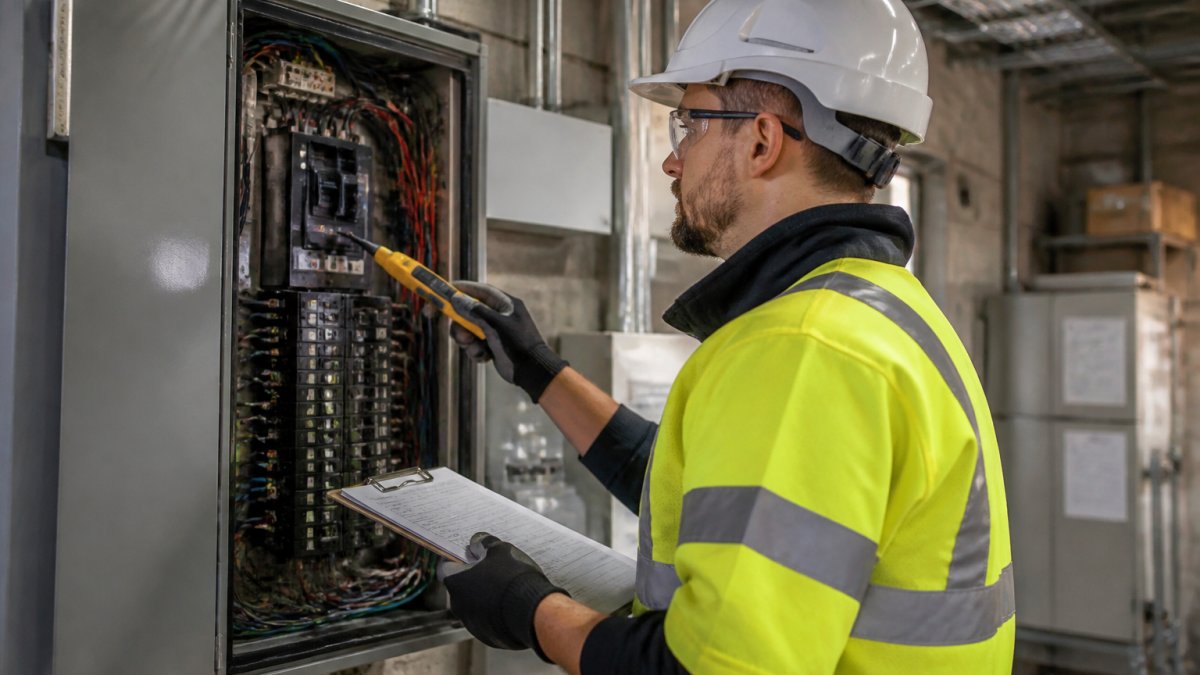
Start with the main distribution board and switchgear, the heart of the system. Look for corrosion, moisture, and signs of overheating.
Check that breaker labels match the circuits they control. A mislabeled panel slows every future repair.
- Look for rust, water stains, or white residue on busbars
- Confirm all covers and dead fronts are secure
- Check for burnt smells or discolored metal
- Test that the main disconnect operates freely
Wiring, Connections, and Visible Damage
Wiring and connections are where small faults turn into big ones. Loose connections create heat, and heat starts fires.
Look for cracked insulation, exposed copper, and rodent damage. Check that conduit and cable trays are supported and sealed.
- Tighten and test accessible terminations
- Replace any damaged insulation on sight
- Confirm grounding and bonding are intact
- Watch for warm outlets or flickering circuits
Skipping loose-connection checks is the most common mistake. A single loose lug can overheat and melt a panel, turning a minor repair into a full shutdown.
Electrical Panel Maintenance Checklist: Breakers, Protection, and Overheating
An electrical panel maintenance checklist focuses on breakers, protective devices, and heat. These parts fail quietly, so testing matters more than looking.
Breaker and Protective Device Testing
Check that each breaker trips as designed. A breaker that holds when it should trip is more dangerous than one that trips too often, because it lets an overload continue until something else fails.
- Thermal-magnetic breakers: test the trip mechanism by simulating an overload or using a primary injection tester. Confirm the trip time falls within the manufacturer’s published curve.
- Ground-fault circuit interrupters (GFCIs): press the test button and confirm the breaker trips, then reset it. Test portable GFCIs at the point of use.
- Arc-fault circuit interrupters (AFCIs): use the test button and verify the indicator shows a trip. AFCI nuisance trips often point to a shared neutral or a loose connection upstream.
- Surge protective devices (SPDs): check the status indicator. Many SPDs show a green light when functional and red or dark when the cartridge is spent.
Confirm protection devices match the load they serve. A 20-amp breaker on a 15-amp circuit, or a fuse replaced with a higher-rated one, defeats the protection entirely.
Overheating and Hot-Spot Detection
Overloaded circuits show up as warm breakers, tripped switches, and dimming lights. Infrared or thermal scanning finds hot spots before they fail.
A thermal scan reads surface temperatures and flags anything running hotter than normal. The scan works best under load, so run it when the building is drawing typical power, not at 3 a.m. when most equipment is off.
Common hot spots to watch:
- Breaker terminals and busbar connections
- Neutral and ground bars
- Conduit entries and cable terminations
- Motor control centers and disconnect switches
A qualified thermographer compares each reading against a baseline and against similar components in the same panel. A connection running 15 to 20 degrees Celsius above its neighbors is a warning sign even if the absolute temperature looks acceptable.
For more on how these systems are meant to perform, see Electrical Safety Authority guidance on electrical equipment.
| Check | Frequency | Who Does It |
|---|---|---|
| Visual panel inspection | Monthly | Property manager |
| Breaker trip test | Annually | Licensed electrician |
| Infrared scan under load | Annually | Licensed thermographer |
| Torque and connection check | Annually | Licensed electrician |
| GFCI/AFCI test-button check | Quarterly | Property manager |
A thermal scan taken with the building unloaded will miss the hot spots that matter most. Schedule it during peak operating hours.
Commercial Electrical Maintenance Schedule: Task Frequency by System and Risk
A commercial electrical maintenance schedule sets how often each task happens, based on risk. High-risk systems get checked more often. Low-risk items can wait.
Most checklists stop at a flat list of intervals. That is where they fail in practice. A schedule only works when it is tied to risk level, paired with a documentation trail, and closed out when defects are fixed.
Task Frequency by System and Risk Level
| System | Routine Check | Interval | Risk Tier |
|---|---|---|---|
| Main distribution board and switchgear | Visual inspection | Monthly | High |
| Breakers and protective devices | Trip test | Annually | High |
| Wiring and terminations | Torque and thermal check | Annually | High |
| Emergency lighting and exit signs | Press-test and battery check | Monthly | High |
| Backup generator | Load test and fuel check | Monthly and annually | High |
| Lighting and fixtures | Visual and lamp replacement | Quarterly | Medium |
| Outlets and receptacles | Visual and GFCI test | Quarterly | Medium |
| Panel labeling and directory | Accuracy audit | Annually | Low |
Risk level drives the schedule. A building with heavy equipment, fuel infrastructure, or continuous operations needs tighter intervals than a quiet office. A data center or cold-storage facility may need monthly thermal scans rather than annual ones.
Documentation, Defect Tracking, and Closeout
A checklist without a record is just a walk-through. Documentation turns it into a maintenance history that supports insurance claims, code compliance, and resale due diligence.
A workable record captures four things for every task:
- What was checked, the specific item and location, not just “panel.”
- When, date and time, plus the name of the person who performed it.
- What was found, readings, observations, and photos where relevant.
- What was done, repair, replacement, referral, or no action needed.
Defect tracking follows a simple loop:
- Log the defect with a severity rating.
- Assign a corrective action and an owner.
- Schedule the repair within a defined window based on severity.
- Verify the repair and close the item.
- Retain the record for the period your insurer, regulator, or lease requires.
A common pattern is to keep records for at least the life of the equipment, and longer for anything tied to a fire-safety system. Check your insurance policy and any applicable provincial requirements for retention periods.
Prioritizing Findings by Severity and Business Impact
Not every finding deserves the same response. Rank them:
- Urgent (act now): exposed live parts, burning smells, hot panels, failed emergency lighting, water in an electrical enclosure. Isolate and repair immediately.
- Planned (act within weeks): loose terminations, aging breakers, mislabeled panels, degraded insulation. Schedule before the next operating cycle.
- Routine (act within the year): cosmetic damage, minor labeling gaps, lamp replacements. Fold into the next scheduled visit.
A hot panel outranks a flickering light. Fix safety issues first, then reliability, then cosmetic items. This ranking lets a property manager defend spending decisions to ownership without treating every finding as equally urgent.
Group tasks by system, not by date. It is faster to test every emergency light in one visit than to spread them across the year.
Lighting, Emergency Lighting, and Exit Sign Checks
Lighting and emergency lighting checks protect people during a power failure. When the main supply drops, these systems must work.
Test every exit sign and emergency light on a set schedule. Confirm backup batteries hold a charge.
- Press the test button on each emergency light
- Confirm exit signs are lit and visible
- Check backup generator fuel and start-up
- Replace failed lamps and batteries right away
Emergency power failures during an evacuation are a serious safety and legal risk. For the rules that apply, see National Fire Code of Canada.
Electrical Safety Checklist for Property Managers: Roles, Records, and Risk
An electrical safety checklist for property managers separates what you can do from what needs a licensed electrician. Getting this wrong is both a safety risk and a legal one.
What Property Managers Can Check and What Requires a Licensed Electrician
Property managers can handle visual checks and simple tests. Anything involving live parts, panels, or wiring needs a licensed electrician.
You can do:
- Visual inspection of outlets, cords, and fixtures
- Press-test emergency lights and exit signs
- Log defects and schedule repairs
- Keep maintenance records up to date
A licensed electrician must do:
- Open panels or switchgear
- Test or replace breakers
- Torque connections
- Run thermal scans
- Any work on live circuits
This is where Bighorn Electric helps. Our licensed, insured, and bonded electricians handle the work property managers cannot. We offer a 48-hour on-site response for urgent issues, so a failed panel does not shut your building down for days.
Prioritize findings by severity. A hot panel outranks a flickering light. Fix safety issues first, then reliability, then cosmetic items.
For provincial rules on who may perform electrical work, check Technical Safety BC licensing requirements.
Frequently Asked Questions
What does an electrical service checklist include?
An electrical service checklist covers the main distribution board and switchgear, circuit breakers, wiring and connections, outlets, lighting, emergency lighting and exit signs, backup generators, and signs of overheating or corrosion. It also records infrared scan results, load readings, and any defects found. A commercial property electrical maintenance checklist should note the date, the person who performed each task, and the corrective action taken so the next inspection builds on a clear history.
How often should electrical systems in a commercial building be inspected?
High-risk systems such as emergency lighting, exit signs, and backup generators need monthly functional tests. Distribution boards, switchgear, and circuit breakers are typically checked quarterly, while a full electrical inspection checklist for commercial buildings is best completed annually by a licensed electrician. Infrared scans are most useful during peak load, so schedule them when the building is drawing maximum power. Adjust frequencies based on equipment age, load trends, and any recurring faults.
Which electrical maintenance tasks should be handled by a licensed electrician?
Any work inside a panel, switchgear, or distribution board, tightening or replacing connections, breaker replacement, infrared scanning, and load testing should be done by a licensed electrician. Property managers and facility staff can handle visual checks for damage, corrosion, or hot spots, confirm that emergency lighting and exit signs illuminate, test generator start cycles if trained, and keep documentation up to date. Keep a clear boundary between observation and repair so nobody works live equipment without the right qualifications.
How do I prioritize electrical defects found during a commercial inspection?
Rank findings by severity and business impact. Immediate hazards such as exposed live conductors, burning smells, scorched panels, or failed emergency lighting need same-day attention. Loose connections, overloaded circuits, and overheating hot spots are high priority because they lead to fire risk and downtime. Corrosion, worn wiring, and aging breakers are medium priority and can be scheduled. Cosmetic or documentation gaps are low priority. A commercial electrical maintenance schedule should reflect these tiers so urgent work is never delayed by routine tasks.
A commercial property’s electrical system only stays safe if someone checks it on a schedule. Miss the checks, and small faults become fires, outages, and costly repairs.
Bighorn Electric brings over 14 years of experience to commercial and residential clients, with licensed, insured, and bonded electricians. We offer a 48-hour on-site response for urgent needs and tailored solutions for every property. Book online with Bighorn Electric and keep your building running safely.

0 Comments