
Last Updated: November 17, 2026
Quick Summary
Emergency electrical repair services in 2026 triage your call first, then dispatch a licensed electrician who diagnoses the fault on site before any repair begins. True emergencies include sparks, smoke, burning smells, a hot panel, or a downed power line, while a single dead outlet is a scheduled repair.
- A breaker that trips twice in a row signals a fault, so stop resetting it and call an electrician.
- For fire, smoke, a downed line, or a shock injury, call 911 first and the electrician second.
- Never spray water on an electrical fire or reach into a panel with a wet hand.
- Ask whether the make-safe is included in the call-out fee or billed separately.
- Bighorn Electric offers a 48-hour on-site response guarantee for urgent issues.
Table of Contents
- What Counts as an Electrical Emergency in 2026
- Electrical Emergency Warning Signs You Should Never Ignore
- What to Do During an Electrical Emergency Before Help Arrives
- Faulty Breakers, Dead Panels and Power Outages: What the Symptoms Mean
- How Emergency Electrical Repair Services Work, From Call to Completion
- Emergency Electrical Repair Insurance Coverage: What’s Typically Covered
- Electrical Repair Documentation for Insurance Claims
- Book Your Emergency Electrical Repair With Bighorn Electric
- Frequently Asked Questions
What Counts as an Electrical Emergency in 2026
An electrical emergency is any fault that threatens people, property, or the power supply right now: sparks, smoke, burning smells, a hot panel, or a live wire on the ground. Anything that can wait for a scheduled visit is a repair, not an emergency.
Here’s the throughline for this guide: most people overestimate what counts as an emergency and underestimate what to do in the first five minutes. That gap causes real damage. A scorched outlet reported the same day is a cheap fix. The same outlet ignored for a week is a fire call.
Emergency vs. Non-Urgent: How to Tell the Difference
The test is simple. Ask two questions: is there heat, smoke, sparks, or a shock risk, and is anyone exposed to it?
- Emergency: burning smell from an outlet or panel, visible sparks, smoke, a shock when touching an appliance, a downed power line, water on live equipment, or a total loss of power to a commercial kitchen or farm pump mid-operation.
- Non-urgent: one dead outlet in a room, a light fixture that flickers occasionally, a tripped breaker that resets and stays on, or a switch that feels loose but works.
One rule we would give any homeowner: a breaker that trips twice in a row is not a nuisance. It is the circuit telling you something is wrong. Stop resetting it and get it looked at.
Electrical Emergency Warning Signs You Should Never Ignore
Burning smells, smoke, sparks, and scorch marks are the warning signs that demand an immediate call, not a calendar reminder. Each one points to heat where heat should never be, and heat is what starts electrical fires.
Watch for these:
- A burning or fishy smell near outlets, switches, or the panel
- Brown or black scorching on a faceplate
- Buzzing or sizzling from a breaker or receptacle
The last two are the quiet ones. Most people touch a warm plate, shrug, and move on. That warmth is resistance, and resistance builds.
What to Do During an Electrical Emergency Before Help Arrives
Your first move is to cut the power at the panel if it is safe to reach, then get everyone clear of the affected area. For local, step-by-step guidance on what to do first in an electrical emergency in Cranbrook, see our dedicated guide. Safety comes before diagnosis, and it comes before phone calls. The steps below are organized by hazard so you can act on what you are actually seeing rather than trying to remember a single generic list.
If you see smoke, flames, or active arcing
- Move people and pets out of the room and, if smoke is spreading, out of the building.
- Call 911 from outside. Do not re-enter to investigate.
- If the panel is dry, reachable, and not the source of the smoke, switch off the main breaker on your way out. If the panel itself is smoking, arcing, or hot to the touch, leave it alone.
- Do not spray water on an electrical fire. Water conducts, and a stream can bridge you to live current.
- If you have a Class C-rated extinguisher and the fire is small and contained, you may use it, but only if you have a clear exit behind you. Otherwise, evacuate.
If you smell burning but see no flames
A burning or fishy smell near an outlet, switch, or panel is often overheated insulation or a failing connection. Treat it as an emergency even without visible smoke.
- Shut off the circuit at the panel if you can identify it, or the main breaker if you cannot.
- Unplug nearby appliances and do not use the affected outlets.
- Leave the building if the smell is strong or spreading, and call from outside.
- Call an electrician. Do not wait to see whether the smell clears on its own.
If someone has received a shock
- Do not touch the person if they may still be in contact with the source. Shut off power at the panel first.
- Once the source is de-energized, call 911. Electrical shocks can cause internal injury, burns, and heart rhythm problems that are not visible.
- Even if the person feels fine, encourage a medical assessment. Delayed symptoms are common.
If a power line is down
- Assume the line is live and the ground around it is energized. Keep at least the length of a bus away, and keep others back.
- Do not drive over it, touch it with anything, or approach a vehicle that is in contact with it. If someone is inside a vehicle touching a downed line, tell them to stay inside and call 911.
- Call 911 and the utility. Do not call an electrician first; the utility must de-energize the line before anyone can work safely.
If water is contacting electrical equipment
- Do not enter standing water that may be in contact with outlets, cords, or a panel.
- Shut off the main breaker only if you can reach the panel without stepping in water.
- Call an electrician. Water-damaged wiring and equipment need to be assessed and often replaced before power is restored.
What not to do while you wait
- Do not reset a breaker that has tripped twice in a row. Repeated trips indicate a fault, and resetting it re-energizes the problem.
- Do not open a panel cover, pull a meter, or attempt to isolate a circuit you cannot identify.
- Do not use an extension cord to route power around a dead circuit; that bypasses the protection that tripped in the first place.
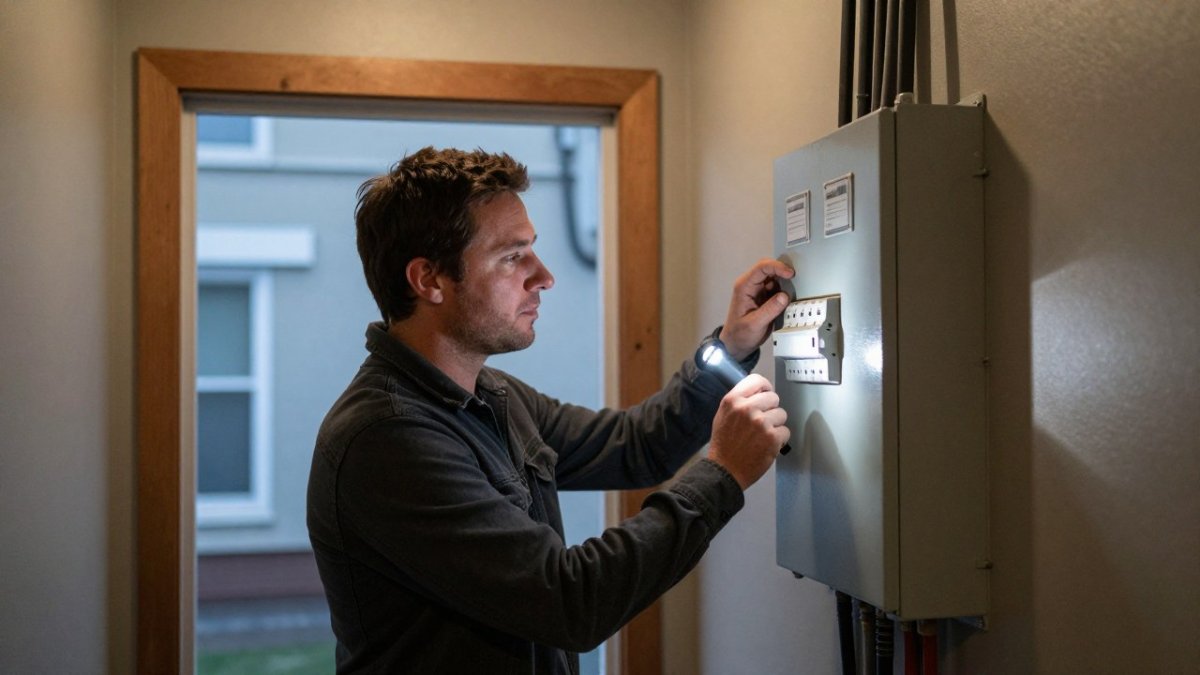
Watch out: never spray water on an electrical fire or reach into a panel with a wet hand. Water and live current are the fastest way to turn a small fault into a serious injury.
When to Evacuate or Call 911
Evacuate when you see flames, heavy smoke, or a downed line touching a vehicle or fence, and call 911 from a safe distance. A downed power line can energize the ground around it, so keep well back and warn others away.
For anything short of fire, call an electrician. For fire, smoke filling a room, a downed line, or a shock injury, call emergency services first and the electrician second.
Faulty Breakers, Dead Panels and Power Outages: What the Symptoms Mean
A tripping breaker, a dead panel, and a partial power loss each point to a different problem, and the symptom tells a licensed electrician where to look.
For a full walkthrough of what to do while the lights are out, see our guide on the steps to take during an electrical power outage.
What most guides miss is how often a “dead” panel is really a tripped main or a utility issue.
How Emergency Electrical Repair Services Work, From Call to Completion
Emergency electrical repair services follow a predictable path: you call, a dispatcher gathers details, an electrician is scheduled, and the fault is diagnosed on site before any repair begins. Knowing the sequence removes the guesswork and helps you ask the right questions at each stage.
Stage 1: Intake and triage
The dispatcher’s job is to separate a true emergency from a same-day or next-day repair. Expect questions about what you see and smell, whether anyone has been shocked, whether the panel is hot or arcing, and whether water is involved.
A common pattern is that callers describe a symptom (“the power is out”) rather than the hazard (“the panel is buzzing and warm”). The hazard drives the response.
Stage 2: Dispatch and ETA
Once triaged, you should receive an ETA and a callback number. Ask whether the ETA is a window or a fixed time, and ask what happens if the electrician is delayed. For after-hours calls, confirm whether the after-hours rate applies from the moment of dispatch or from arrival.
Stage 3: On-site assessment and diagnosis
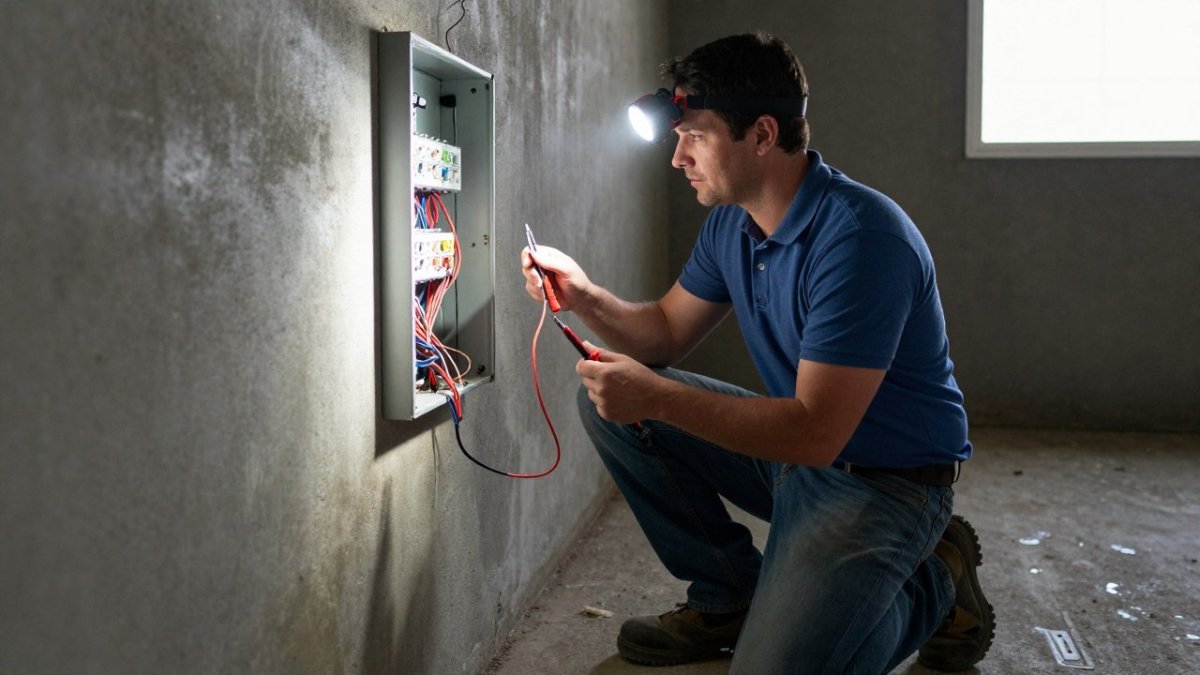
Diagnosis typically involves checking voltage at the panel, testing the affected circuit under load, and inspecting for heat damage, loose connections, and moisture. You should receive a clear explanation of the fault and the repair options before work begins.
Stage 4: Temporary isolation or make-safe
Not every fault can be fully repaired on the first visit. A common pattern is to isolate the faulty circuit, cap and label conductors, and restore power to the rest of the building while parts are ordered or a follow-up is scheduled. Ask whether the make-safe is included in the call-out fee or billed separately.
Stage 5: Repair and testing
Ask for the test results in writing if the fault involved a panel or service.
Stage 6: Documentation and follow-up
Keep this with your photos and invoices; it is the record your insurer will ask for.
What drives cost and response time
Response time depends on triage priority, time of day, weather events that create multiple simultaneous calls, and travel distance.
Bighorn Electric offers a 48-hour on-site response guarantee for urgent issues, with clear communication on ETAs. If you are still choosing who to call, our step-by-step guide to finding an emergency electrician walks through the questions to ask before you book.
Here is the six-stage path an emergency electrical repair follows, from your first call to the final paperwork.
| Stage | What happens | What to ask or expect |
|---|---|---|
| 1. Intake and triage | Dispatcher separates true emergency from same-day repair | Expect questions on hazards, shocks, water |
| 2. Dispatch and ETA | Electrician scheduled and ETA given | Ask if ETA is a window or fixed time |
| 3. On-site assessment | Voltage checks, load testing, heat and moisture inspection | Clear explanation of fault before work begins |
| 4. Temporary isolation | Faulty circuit isolated, power restored to rest of building | Ask if make-safe is in the call-out fee |
| 5. Repair and testing | Fault repaired and tested | Ask for test results in writing |
| 6. Documentation and follow-up | Written record provided | Keep with photos and invoices for insurer |
Emergency Electrical Repair Insurance Coverage: What’s Typically Covered
Home and commercial property policies commonly cover sudden, accidental electrical damage, such as a short circuit that starts a fire, but they usually exclude gradual wear, maintenance, and code upgrades. Coverage depends on your policy wording, so read the exclusions before you assume.
What tends to be covered:
- Fire or smoke damage caused by an electrical fault
- Sudden damage from a surge or lightning strike
- Water damage from a burst pipe that reaches wiring
What tends to be excluded:
- Repairs for worn or aging wiring
- Upgrades needed to meet current code
- Faults from neglected maintenance
For a fuller breakdown, read our article on what insurance covers for emergency electrical repair. Document everything as it happens, because claims are decided on records.
Electrical Repair Documentation for Insurance Claims
Good documentation is what turns a stressful claim into a paid one. Photograph the damage before anything is moved, keep the electrician’s written diagnosis, and save every invoice and receipt.
Build a simple file with:
- Dated photos of the fault and any damage
- The electrician’s written assessment and repair scope
- Invoices showing parts and labor
Ask your electrician for a report you can hand to the insurer. A clear written diagnosis, naming the fault and the repair performed, carries far more weight than a verbal description.
Book Your Emergency Electrical Repair With Bighorn Electric
When a fault can’t wait, the difference is response and clarity. Bighorn Electric brings licensed, insured, and bonded electricians and a 48-hour on-site response guarantee for urgent issues.
If you are dealing with a fault right now, contact us to request service and tell us what you are seeing.
A fault that smells like burning or throws sparks is not a wait-and-see problem.
Frequently Asked Questions
What counts as an electrical emergency?
An electrical emergency is any situation where wiring, a panel or an appliance poses an immediate risk of fire, shock or serious damage. Burning smells, visible sparks, smoke from an outlet, a panel that is hot to the touch, or a downed power line all qualify. Repeated breaker trips with no obvious cause also warrant urgent attention. If you are unsure, treat it as an emergency and call a licensed electrician rather than waiting to see whether the problem settles.
Does home insurance cover emergency electrical repair?
Coverage depends on the cause. Most home policies cover sudden, accidental damage such as a short circuit that starts a fire, but they usually exclude damage from worn-out wiring or lack of maintenance. Emergency electrical repair insurance coverage may also include temporary measures like making the property safe. Check your policy wording and call your insurer before work begins, and keep every invoice and report from the electrician.
What should I document before emergency electrical repairs begin?
Photograph or film the affected area before anyone touches it: the panel, the outlet, scorch marks, and any smoke or water damage. Note the date, time and what you observed. Keep the electrician’s diagnosis, invoice and any parts replaced, since electrical repair documentation for insurance claims is often required to support a payout. A written report from a licensed electrician carries far more weight with adjusters than photos alone.
Can I turn off the power during an electrical emergency?
Yes, if you can reach the main breaker safely and your hands are dry. Switch off the main breaker only if the panel is not hot, sparking or smoking. If the panel itself is the problem, leave it alone and evacuate. Never touch a person who is in contact with live wiring; call 911 first. Once the power is off, keep everyone away from the affected area until a licensed electrician has assessed it.


0 Comments