
Last Updated: November 10, 2026
Quick Summary
For emergency electrical service in Cranbrook, first cut the power at the affected breaker, move people and pets clear, and call 911 if there is smoke, fire, or a downed line before calling your electrician. Treat any heat, smoke, sparks, or burning smell as an emergency, and never touch a smoking or sparking panel.
- Treat heat, smoke, sparks, or a burning smell as an emergency; a breaker that trips once and resets cleanly is a scheduled repair.
- Never touch a person in contact with live current or handle wiring with wet hands.
- Unplug a smoking appliance only when the plug is cool and dry; never throw water on an energized appliance.
- Do not reset a breaker repeatedly when it trips again after reset.
- Bighorn Electric offers a 48-hour on-site response guarantee for urgent issues.
Table of Contents
- How to Tell You Have an Electrical Emergency on Your Hands
- Electrical Emergency Safety Steps to Take Before Anyone Arrives
- What a Burning Smell From an Electrical Outlet Is Telling You
- What to Tell an Emergency Electrician When You Call
- What Happens During an Emergency Electrical Repair Visit
- Emergency Electrical Repair Insurance Coverage: What Home and Property Policies Usually Handle
- Book Emergency Electrical Service With a Team That Shows Up
- Frequently Asked Questions
How to Tell You Have an Electrical Emergency on Your Hands
An electrical emergency is any fault that poses an immediate risk of fire, shock, or injury, and it needs a licensed electrician right away. At Bighorn Electric, we take calls where a homeowner isn’t sure whether a sparking outlet is a real emergency or just an annoyance. Knowing the difference protects your home and your budget.
Here’s the test we use: if the problem involves heat, smoke, sparks, or a burning smell, treat it as an emergency. If a breaker trips once and resets cleanly, it’s a repair to schedule, not a crisis.
The clearest warning signs that demand emergency electrical service include:
- A burning smell from an outlet, switch, or panel
- Scorch marks, melted plastic, or discolored faceplates
- Repeated breaker trips with no obvious cause
- Buzzing, crackling, or sizzling sounds from wiring
- Warm or vibrating outlets and switches
- Sparking when you plug something in
Watch out: a warm outlet is not a minor quirk. Heat at a receptacle usually means a loose connection or overloaded circuit, and both are fire risks that get worse with every use.
Electrical Emergency Safety Steps to Take Before Anyone Arrives
The first thing to do in an electrical emergency is cut the power at the source, then get everyone away from the hazard. Electrical Safety Authority guidance on home electrical hazards is clear that you should never touch a person who is in contact with live current, and never handle wiring with wet hands.
Work through these steps in order:
- Kill the power. Switch off the affected breaker at the panel. If the panel itself is smoking or sparking, do not touch it. Call for help and evacuate.
- Move people and pets back. Keep everyone clear of the outlet, appliance, or panel until it’s been checked.
- Unplug if it’s safe. If an appliance is smoking, unplug it only when the plug is cool and dry. Otherwise leave it.
- Smother flames carefully. For a small fire, use a fire extinguisher rated for electrical fires. Never throw water on an energized appliance.
- Call 911 if there’s smoke, fire, or a downed line. Then call your electrician.
- Do not reset the breaker repeatedly. A breaker that trips again after reset is telling you something is wrong.
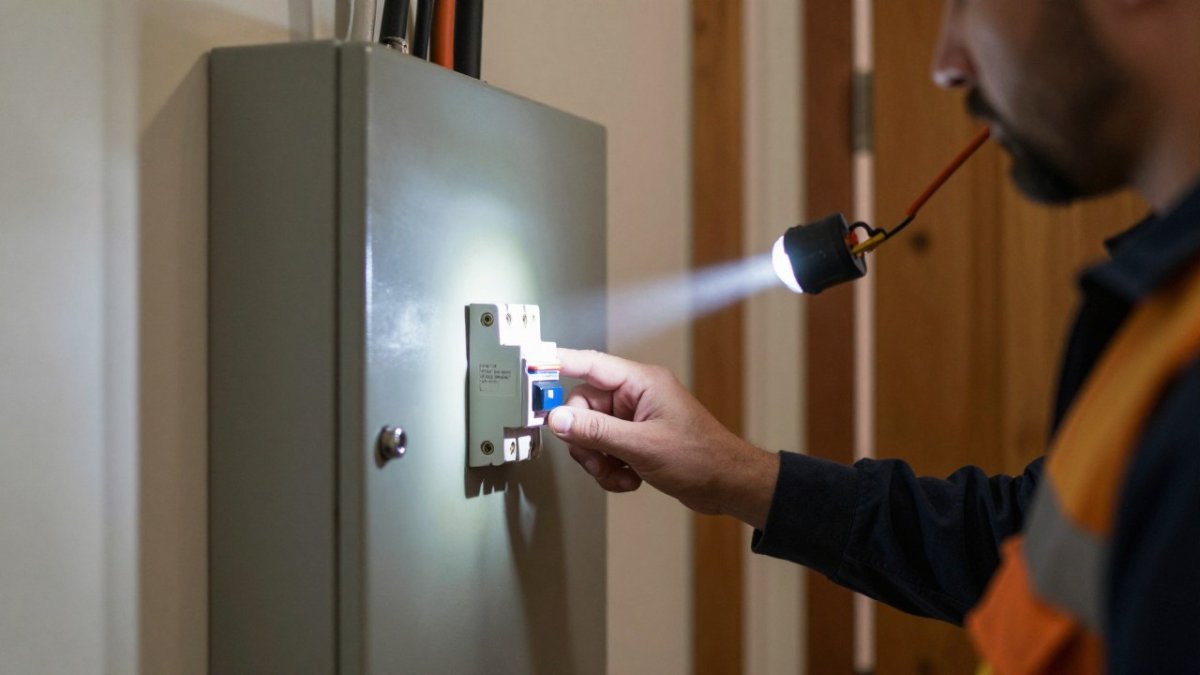
For a full walkthrough of what to do while the power is out, our team put together 7 steps to take during an electrical power outage.
Work through these steps in order when an electrical emergency strikes.
| Step | What to do |
|---|---|
| 1 | Kill the power at the affected breaker; do not touch a smoking or sparking panel |
| 2 | Move people and pets clear of the outlet, appliance, or panel |
| 3 | Unplug a smoking appliance only if the plug is cool and dry |
| 4 | Smother small flames with an extinguisher rated for electrical fires; never use water |
| 5 | Call 911 if there is smoke, fire, or a downed line, then call your electrician |
| 6 | Do not reset the breaker repeatedly |
What a Burning Smell From an Electrical Outlet Is Telling You
A burning smell from an electrical outlet almost always signals overheating behind the wall, and it is one of the most urgent reasons to call an electrician. The smell is often described as fishy, acrid, or like hot plastic, and the specific odor can point to the likely mechanism.
What most guides miss is that the smell can come and go. A connection that arcs only under load may smell fine at idle and turn pungent when a heater, dryer, or kettle kicks on.
Use the smell and the circumstances to narrow down where the fault sits:
- Fishy or acrid smell near one receptacle. A failing outlet, a backstabbed wire that has worked loose, or a device that has overheated internally. Shut off the circuit and stop using that receptacle.
- Hot plastic smell near the panel. A breaker or bus connection is overheating. Do not touch the panel if it is warm, buzzing, or discolored; call for service and keep everyone clear.
- Smell that appears only when a specific appliance runs. The appliance or its cord and plug may be the source, or the circuit may be overloaded. Unplug the appliance only if the plug is cool and dry, and have the circuit checked before reuse.
- Smell throughout a room with no single source. Damaged insulation or a connection inside the wall may be arcing. Treat it as active until an electrician confirms otherwise.
Common causes behind these smells include a loose wire connection creating resistance and heat, an overloaded circuit drawing more current than the wiring can safely carry, a failing outlet or backstabbed wiring that has worked loose, and damaged insulation exposing conductors.
Watch out: a smell that fades after you shut off the breaker does not mean the problem is gone. It means the circuit is no longer energized. The fault is still there and will return the next time the circuit is loaded.
If you smell burning and cannot trace it to a specific appliance, shut off the circuit and call for service.
What to Tell an Emergency Electrician When You Call
When you call an emergency electrician, give the dispatcher four things: your exact location, what you’re seeing or smelling, whether the power is off, and whether anyone is at risk. Clear details help the team arrive prepared.
Here’s what we ask every caller:
- Address and access notes. Where’s the panel? Is there a dog? Is the driveway clear?
- The symptom. Smoke, sparks, burning smell, dead circuit, or a downed line?
- What you’ve already done. Did you shut off the breaker? Have you unplugged anything?
- Whether it’s still active. Is the smell or sparking ongoing, or did it stop when you killed power?
- Property type. Home, commercial building, farm, or fuel site, since each needs different gear.
Vetting a contractor before you call matters too. Our guide on how to find an emergency electrician covers the licence and insurance checks worth doing in advance.
What Happens During an Emergency Electrical Repair Visit
During an emergency electrical repair visit, a licensed electrician runs a diagnostic assessment, isolates the fault, and makes the repair safe before restoring power. The goal is to stop the hazard first and fix it properly second.
Here’s how a typical call unfolds:
- Arrival and walkthrough. We confirm the symptom and check the panel and affected circuits.
- Diagnostic assessment. Using a multimeter and fault-finding, we trace where the problem originates.
- Make it safe. We isolate the faulty circuit and address the immediate hazard.
- Repair or replace. Depending on findings, we repair the connection, replace a failed device, or schedule a larger fix.
- Test and verify. We restore power and confirm the circuit holds under load.
Bighorn Electric is licensed, insured, and bonded, and our residential work covers everything from panel repairs to new installations. You can see the full scope on our residential services page.
Emergency Electrical Repair Insurance Coverage: What Home and Property Policies Usually Handle
Most home and property policies cover sudden, accidental electrical damage, but they often exclude failures caused by poor maintenance or gradual wear. The deciding factor is usually causation: what failed, why it failed, and whether the damage was sudden or the result of a long-developing condition.
In practice, policies tend to handle fire damage caused by an electrical fault, damage from a sudden short circuit or surge, and resulting water or smoke damage.
That distinction matters at the moment of the emergency, because the way the fault is documented can affect how the claim is assessed. Before the electrician starts, and again once the cause is identified, capture:
- Photos and video of the affected area, including any scorch marks, melted plastic, or smoke staining
- The date and time the problem started and when you shut off the circuit
- A written description of what you saw, smelled, or heard, in your own words
- The electrician’s diagnosis of the cause, in writing, once it is known
- Receipts and invoices for any emergency mitigation, such as a fire extinguisher service or temporary repairs
Watch out: cleaning up or discarding a failed device before it has been photographed and described can weaken a claim, because the adjuster may have no way to confirm the cause. Leave the failed component in place until it has been documented, unless it poses an ongoing hazard.
A licensed electrician’s written finding is often the most useful document in the file. It separates a sudden failure from a maintenance issue and gives the adjuster a clear cause to assess.
For a deeper breakdown of how coverage decisions are typically made, read our guide to emergency electrical repair coverage.
Book Emergency Electrical Service With a Team That Shows Up
The hardest part of an electrical emergency is often finding someone who actually answers and arrives. Our 48-hour on-site response guarantee for urgent issues means you get a real ETA, not a vague promise.
Bighorn Electric brings more than 14 years of experience to residential, commercial, petroleum, and agricultural electrical work. That includes specialized petroleum electrical solutions and the electrical side of farm irrigation systems, covering pumps, center pivots, reel guns, service, and parts.
When you call, you get licensed, insured, and bonded electricians. One customer put it simply: “Very responsive. Quality work with great rates.”
If you’re ready to get a problem fixed, contact our team and book emergency electrical service today.
A sparking outlet or burning smell won’t fix itself, and waiting only raises the risk. Bighorn Electric offers a 48-hour on-site response guarantee, licensed and insured electricians, and specialized experience across homes, farms, and commercial sites. Get started with Bighorn Electric and get a real ETA and a safe, properly repaired system.
Frequently Asked Questions
What counts as an electrical emergency?
An electrical emergency is any situation where the electrical system poses an immediate risk to people or property. That includes sparking outlets, smoke or a burning smell from a panel or receptacle, exposed live wiring, a shock that left someone injured, or a downed power line touching a structure. A single tripped breaker with no other symptoms is usually not an emergency, but repeated tripping, buzzing sounds, or scorch marks around a breaker point to a fault that needs urgent attention from a licensed electrician.
Does home insurance cover emergency electrical repairs?
Most home policies in Canada cover sudden accidental damage, such as a fire started by faulty wiring, but they typically exclude the cost of repairing the failed wiring itself, since that falls under maintenance. Coverage depends on the cause and your specific policy wording, so call your insurer before authorizing major work. Keep the electrician’s diagnostic report and photos of the damage; insurers often ask for them when assessing a claim.
How quickly can an emergency electrician respond?
Response times vary by provider and time of day. Bighorn Electric guarantees a 48-hour on-site response for urgent electrical needs, and the team keeps customers updated on their ETA so you are not left guessing. When you call, describe the hazard clearly and ask for the soonest available window. If there is smoke, fire, or a downed line, call 911 or your utility first, then the electrician.
Can I use an appliance after it has tripped a breaker?
Reset the breaker once and see whether it holds. If the breaker trips again with that appliance plugged in, stop using the appliance and unplug it; the fault is likely in the appliance or its cord. If the breaker trips with nothing plugged in, or if it feels hot, smells burnt, or buzzes, leave it off and call an electrician. Repeated resets on a faulty circuit can overheat wiring inside the wall.


0 Comments