

Quick Summary
Fuel site wiring should be visually checked monthly and formally inspected by a licensed electrician about once a year. A qualified inspector should also review hazardous area classification every 2 to 3 years. Any modification triggers an immediate inspection of the affected circuits.
- Site staff should perform monthly visual walk-throughs for damaged covers, seals, and visible wear.
- Routine electrical inspections by a licensed electrician are typically done annually.
- Detailed hazardous area reviews by a qualified inspector are typically every 2 to 3 years.
- Any new dispenser, pump, or conduit reroute requires a post-change inspection of affected circuits.
- Flickering lights, warm outlet boxes, or repeated breaker trips call for an immediate inspection.
Table of Contents
- Recommended Inspection Intervals for Fuel Site Wiring
- Signs a Fuel Site Wiring Inspection Is Needed Sooner
- Step-by-Step: Fuel Site Electrical Inspection Checklist
- Hazardous Location Wiring Inspection: Scope and Testing
- Inspecting Fuel Site Wiring After Repairs or Equipment Changes
- Booking Your Fuel Site Wiring Inspection With Bighorn Electric
- Frequently Asked Questions
Why Fuel Site Wiring Needs Regular Inspection
Fuel sites combine electricity with flammable vapours, which is why their wiring carries a higher safety bar than most commercial buildings.
Wiring in these areas is often exposed to moisture, temperature swings, vibration from equipment, and the occasional spill. Over time, seals crack, connections loosen, and insulation degrades.
- Hazardous zones are classified, and the wiring inside them must match that classification
- Corrosion and loose terminations develop slowly and often go unnoticed
- Equipment changes can quietly overload circuits that were sized for older loads
Watch out: Assuming a site that passed last year is still compliant.
Recommended Inspection Intervals for Fuel Site Wiring
A practical inspection schedule combines the minimum requirements in the applicable code with a shorter interval where the site’s risk calls for it. For ongoing upkeep between formal inspections, our commercial electrical maintenance checklist lays out routine items to check. Most operators set a routine formal inspection and supplement it with visual checks between visits.
| Inspection Type | Typical Frequency | Who Performs It | Focus |
|---|---|---|---|
| Visual walk-through | Monthly | Site staff | Damaged covers, seals, visible wear |
| Routine electrical inspection | Annually | Licensed electrician | Connections, grounding, protection devices |
| Detailed hazardous area review | Every 2 to 3 years | Qualified inspector | Classification, sealing, equipment rating |
| Post-change inspection | After any modification | Licensed electrician | Affected circuits and zones |
Intervals Set by the Canadian Electrical Code
The Canadian Electrical Code, CSA C22.1, sets the baseline rules for wiring in hazardous locations, and provincial electrical safety authorities enforce them. Check the current edition and your provincial adoption, because local amendments can change the requirements.
The code itself focuses more on installation and classification than on a fixed inspection calendar. That is why the intervals are best read as a planning framework, not a legal minimum.
How Jurisdiction Changes the Answer
There is no single national inspection interval for fuel-site wiring. The requirement you must meet depends on four things, and they can point in different directions:
- The adopted code edition and local amendments. Provinces and territories adopt CSA C22.1 on their own timelines and with their own amendments, so the edition in force at your site may not be the newest one published.
- The authority having jurisdiction (AHJ). Your provincial or territorial electrical safety authority, or the local inspection authority it delegates to, interprets the code and can impose conditions on a permit that go beyond the base rule.
- Permits and conditions of approval. A permit for a dispenser replacement or a panel upgrade may carry inspection conditions that apply only to that work, and those conditions can outlast the job.
A common pattern is that the code sets the installation standard, the AHJ sets the permit and acceptance process, and the insurer sets the maintenance interval. When those three disagree, the strictest one governs in practice.
A Risk-Based Decision Framework
Use the table as a starting point, then adjust the routine interval using the factors below. The goal is to shorten the interval where the consequence or likelihood of failure is higher, and to lengthen it only where you can document why.
- Site age and wiring vintage: Older wiring, older seals, and equipment installed under an earlier code edition warrant a shorter interval. A site with original wiring from decades ago should not be on the same schedule as a recent build.
- Throughput and duty cycle: High-volume sites wear dispensers, pump controls, and contactors faster. More operating hours means more thermal cycling and more vibration.
- Environment: Heavy moisture, salt air, freeze-thaw cycles, and washdown practices accelerate corrosion and seal degradation. Coastal and northern sites often need a shorter interval than the table suggests.
When to Shorten the Interval Immediately
Some events should trigger an out-of-cycle inspection rather than a wait for the next scheduled visit:
- Flooding, a spill, or water found inside an enclosure
- A lightning strike or a significant power event nearby
- A dispenser strike, vehicle impact, or physical damage to conduit or enclosures
- Repeated breaker trips or a protection device that has operated more than once without a clear cause
Watch out: Extending intervals to save money is a false economy. The cost of a routine inspection is small compared with the cost of a fault, an outage, or an enforcement action after an incident, and an insurer may treat an overdue inspection as a maintenance failure.
Signs a Fuel Site Wiring Inspection Is Needed Sooner
Some problems should trigger an inspection immediately, not at the next scheduled visit. Treat these as urgent:
- Flickering lights or pumps that stall without a clear reason
- Warm or discoloured outlet boxes, junction boxes, or disconnects
- Burning smells near panels or equipment
- Breakers that trip repeatedly
If you see any of these, shut down the affected equipment where it is safe to do so, then call a licensed electrician. Do not keep operating a suspect circuit.
Step-by-Step: Fuel Site Electrical Inspection Checklist
Use this checklist as a starting point for each formal inspection:
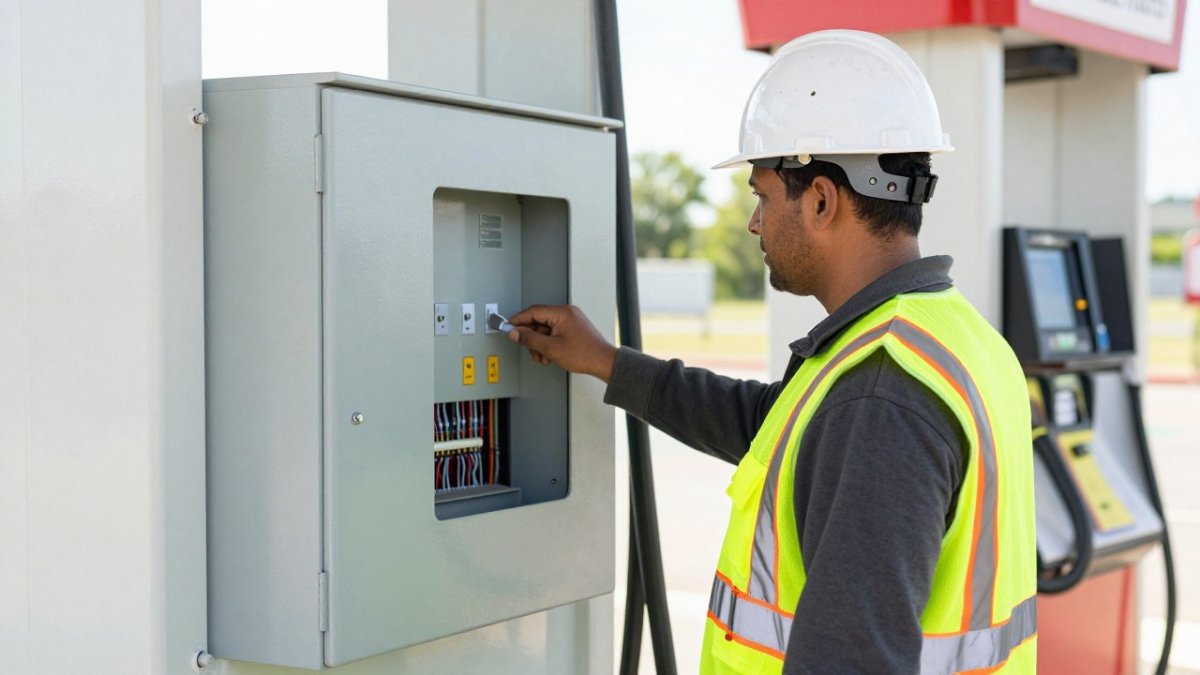
- Confirm the hazardous area classification drawings match the current layout
- Check all enclosures, seals, and gaskets for cracks, gaps, or corrosion
- Inspect outlet boxes and junction points for heat damage or loose terminations
- Verify grounding and bonding connections are tight and intact
Work through the list in order and do not skip the documentation step, since a clear record is what proves the inspection happened.
Hazardous Location Wiring Inspection: Scope and Testing
A hazardous location inspection goes beyond a general electrical check. The inspector confirms that equipment is rated for the zone it sits in, that seals are intact, and that wiring methods suit the classification. Testing typically includes insulation resistance checks, continuity and grounding tests, and verification of protection devices.
What the Scope Covers on a Fuel Site
A fuel-site scope is defined by the classification drawings, not by a generic checklist. The inspection should confirm, at minimum:
- Area classification: The drawings match the current layout, including dispenser islands, vent lines, tank fills, and any equipment added since the last review.
- Equipment rating: Every enclosure, fitting, luminaire, motor, and control device in a classified location is marked for the zone, gas group, and temperature class it sits in.
- Seals and enclosures: Conduit seals are present, correctly located, and intact; gaskets, covers, and fasteners are complete and undamaged.
- Wiring methods: The wiring method suits the classification and the location, including any boundary transitions between classified and unclassified areas.
Testing Methods and What They Tell You
The tests below are common on fuel sites. Which ones apply, and the acceptance values used, should be set by the inspection plan and the applicable standard rather than assumed.
- Insulation resistance testing: Detects degraded insulation and moisture ingress in circuits that look fine visually. Results are compared against the values in the inspection plan and against prior readings for the same circuit.
- Continuity and grounding/bonding resistance testing: Confirms that bonding and grounding paths are continuous and within the expected range. A high reading points to a loose connection or a corroded joint.
- Protection device verification: Confirms that breakers and fuses are the correct rating and type for the circuit and that they have not been substituted.
- Functional testing of emergency shutoffs and alarms: Confirms that the device operates and that the associated circuit responds as intended.
Acceptance criteria should be written before the inspection starts. A reading outside the expected range, a missing seal, or an unrated fitting is a defect that needs correction and re-testing, not a note to revisit later.
Who May Perform Which Part
Competence matters as much as the test itself. A common split is:
- Site staff: Visual walk-throughs, housekeeping, and reporting observations. Staff should not open enclosures in classified locations or perform electrical tests unless trained and authorized.
- Licensed electricians: Electrical testing, repairs, and verification of the work they perform, within the scope of their license and the permit.
- Qualified hazardous-location inspectors: Classification review, assessment of equipment rating and wiring methods, and sign-off on the inspection plan and acceptance criteria.
The authority having jurisdiction sets who may do what and what must be inspected before energization. Confirm the requirement with your provincial or territorial electrical safety authority before the work starts, not after.
Defect Severity and Immediate Response
Not every defect carries the same urgency. A workable severity scheme helps the site decide what to do next:
- Critical: An unrated fitting in a classified location, a missing seal, a broken bonding conductor, or evidence of overheating. Isolate the affected equipment, restrict access, and do not return it to service until corrected and re-tested.
- Major: A degraded gasket, a loose termination, or a protection device of the wrong rating. Schedule correction promptly and re-test the circuit after repair.
- Minor: Housekeeping, labeling, or documentation gaps that do not affect electrical safety. Correct at the next scheduled visit and record the action.
Watch out: A defect that is downgraded to a note because the equipment is still running is the pattern that precedes many incidents. If the defect affects the integrity of a classified location, treat it as critical until a qualified person says otherwise.
For lighting specifically, see our guide on how to choose explosion proof lighting for fuel stations. The full safety requirements for these sites are covered in our resource on electrical safety standards for petroleum facilities.
Inspecting Fuel Site Wiring After Repairs or Equipment Changes
Any repair or equipment change should trigger a targeted inspection of the affected circuits and zones. Replacing a dispenser, adding a pump, or rerouting conduit can change the hazardous area boundaries and the load on shared circuits.
Document the change, inspect the new work against the classification drawings, and test the circuit before returning it to service. Skipping this step is one of the most common reasons sites fail later audits.
Booking Your Fuel Site Wiring Inspection With Bighorn Electric
Bighorn Electric provides petroleum electrical services for fuel infrastructure, and we are licensed, insured, and bonded. We guarantee a 48-hour on-site response for urgent electrical needs.
To schedule an inspection, book your fuel site inspection with our petroleum electrical team or review our commercial inspection services to see how we can fit your site’s schedule.
Keeping fuel site wiring safe comes down to a steady schedule, clear documentation, and prompt attention to warning signs.
Frequently Asked Questions
How often should fuel site wiring be inspected?
Fuel site wiring should be inspected on a recurring schedule set by the applicable provincial electrical authority and the Canadian Electrical Code, Part I, which governs hazardous locations. Many sites also schedule a full inspection every few years and a lighter visual check annually. Sites with older wiring, frequent equipment changes, or visible corrosion or moisture should be inspected sooner. Keep records of each inspection so the interval can be adjusted based on what the findings show over time.
Who is qualified to inspect electrical wiring at a fuel site?
Inspections should be carried out by a licensed electrical contractor or qualified inspector who understands hazardous location requirements under the Canadian Electrical Code. In most provinces, electrical work and inspection must be performed by a certified electrician, and the work must be reviewed by the local electrical inspection authority where required. Confirm the inspector’s licence and experience with fuel infrastructure before booking.
What should a fuel site wiring inspection include?
A thorough inspection covers the condition of conductors, outlet boxes, seals, grounding and bonding, and classified-area equipment, along with insulation resistance and continuity testing where appropriate. The inspector should check for visible damage, moisture ingress, heat marks and unauthorized modifications. Results should be recorded with photos and a list of defects ranked by urgency, so the site operator can act on out-of-service defects immediately.
When should fuel site wiring be inspected after repairs or equipment changes?
Inspect the affected wiring before it is concealed or energized, and again once the work is complete. Any new dispenser, pump, sump or lighting circuit changes the hazardous location classification and the wiring around it, so the inspection should confirm the installation matches the approved design. Keep the inspection report with the site’s maintenance records.


0 Comments