
Last Updated: October 23, 2026
Quick Summary
An electrical panel upgrade starts with an electrical load calculation that adds up your appliance loads and applies demand factors, then compares the total to your panel and service capacity. A licensed electrician confirms whether you need a panel swap, a service upgrade, or both, and pulls the permit before any work begins.
- Check the main breaker rating and meter base first, because panel capacity and service capacity don’t always match.
- A 100-amp service with a full panel leaves no room for a heat pump, let alone an EV charger.
- Never replace a tripping breaker with a larger one, since the breaker protects the wire.
- If existing wiring is sound, an electrician can swap the panel and leave the branch circuits alone.
- Most jobs take one to two days on site, with one to three weeks from first call to power back on.
Table of Contents
- Start With an Electrical Load Calculation for Home Appliances
- Signs You Need an Electrical Panel Upgrade
- Modern Appliance Requirements and Your Electrical Capacity
- Can You Upgrade an Electrical Panel Without Rewiring?
- Options Short of a Full Electrical Panel Upgrade
- Electrical Panel Upgrade Cost: What Drives the Price
- The Step-by-Step Electrical Panel Upgrade Process
- Phase 1: Assessment and Load Calculation (Day 1)
- Phase 2: Permit Application (Days 1-5)
- Phase 3: Utility Coordination (Days 3-10)
- Phase 4: Panel Removal and New Installation (Day 1 of on-site work)
- Phase 5: Inspection (Days 1-5 after installation)
- Phase 6: Power Restoration and Walkthrough (Same day as inspection, usually)
- Frequently Asked Questions
Start With an Electrical Load Calculation for Home Appliances
Before you call anyone, you need a number. An electrical load calculation tells you how much power your home actually draws, and it’s the first step in any electrical panel upgrade.
Most homeowners skip this step. They see a full panel and assume they need more power. Sometimes they do. Sometimes they just need a smarter layout.
The math matters because your panel has a hard limit. Add up what you run, then compare it to what you have.
Appliance-by-Appliance Load Assessment
Walk through your home and list every major load. Here’s a practical checklist we use on site:
- Electric range or cooktop
- Oven (wall or built-in)
- Irrigation pump (for farm and acreage properties)
Note the wattage on each nameplate. Add them up, then apply a demand factor, because not everything runs at once. A licensed electrician runs the official calculation for your permit.
How to Estimate Existing and Planned Loads
A nameplate wattage is the starting point, not the answer.
Step 1: Convert watts to amps. Divide the wattage by the voltage. A 7,200-watt dryer on a 240-volt circuit draws 30 amps.
Step 2: Separate continuous and non-continuous loads. A continuous load runs for three hours or more, an EV charger, a water heater, a heat pump in winter. Non-continuous loads are short bursts, a microwave, a coffee maker, a table saw. Continuous loads get a 125% multiplier in code calculations because they run long enough to heat wiring.
Step 3: Apply demand factors. You don’t add every appliance at full draw. Common demand factors include:
- The first 8,000 watts of general lighting and receptacles at 100%, the remainder at 40%
- Electric ranges: the first 8,000 watts at 80%, the remainder at 40% (for a single range)
- Dryers: 5,000 watts minimum, or the nameplate rating if higher
These are simplified examples. The actual factors depend on the calculation method your electrician uses and the local code edition in force.
Step 4: Check simultaneous-use demands. This is where most homeowners get surprised.
Panel Capacity vs. Service Capacity
These two get confused constantly. Panel capacity is what the breaker box itself can hold. Service capacity is what the utility delivers to your home.
You can have a 200-amp panel fed by a 100-amp service. The panel looks ready. The service isn’t.
The reverse also happens. A small panel on a large service chokes your circuit count. That’s a cheaper fix.
Check the main breaker rating and the meter base before you plan anything. The main breaker tells you the panel rating. The meter base and service entrance cable tell you the service rating. They don’t always match.
A load calculation is not a guess. It’s a documented sum of what you have, what you plan to add, and how those loads overlap. Bring your list and your nameplate photos to your electrician, it speeds up the assessment and gives you a realistic picture of whether you need a panel swap, a service upgrade, or neither.
Signs You Need an Electrical Panel Upgrade
The clearest sign is a breaker that trips every time you run two big appliances at once. That’s your panel telling you it’s at its limit.
Other signals show up over time. Watch for these:
- Breakers that trip often, even under normal loads
- Fuses instead of breakers (a fuse box is well past its service life)
- A panel with no spare slots for a new circuit
Any of these means it’s time to call a licensed electrician. Warm breakers and buzzing are fire hazards, not annoyances. Get those checked right away.
Modern Appliance Requirements and Your Electrical Capacity
Your electrical capacity has to match how you actually live. A home built in 1975 had a fridge, a stove, and a few lamps. Today that same home runs a heat pump, an EV charger, and a tankless water heater.
Here’s what modern appliances demand:
| Appliance | Typical Circuit | Why It Matters |
|---|---|---|
| Electric range | 40-50A dedicated | Needs its own breaker |
| Tankless water heater | 2-3 dedicated circuits | High draw, often 120A total |
| EV charger | 40-50A dedicated | Adds a large continuous load |
| Central heat pump | 30-40A dedicated | Runs long cycles in winter |
| Hot tub | 50A dedicated | Continuous load when heating |
| Irrigation pump | Varies by size | Farm and acreage staple |
Older panels often can’t fit these circuits. A 100-amp service with a full panel leaves no room for a heat pump, let alone an EV charger.
High-Demand Appliances and Dedicated Circuits
A dedicated circuit serves one appliance and nothing else. Modern high-demand appliances need them. Sharing a circuit with lights or outlets causes nuisance trips and overloaded circuits.
The big four that always need their own circuit:
- Electric range or cooktop
- Clothes dryer
- Water heater
- EV charger
Add a heat pump, hot tub, or shop welder and the list grows. Each one needs a breaker slot. That’s why capacity planning starts before you buy the appliance.
Never replace a tripping breaker with a larger one. That’s a common DIY mistake, and it defeats the breaker’s job. The breaker protects the wire. Upsize the breaker and the wire overheats inside your walls. That’s how house fires start.
Can You Upgrade an Electrical Panel Without Rewiring?
Yes, sometimes. If your existing wiring is in good shape, an electrician can swap the panel and leave the branch circuits alone.
The catch is the wiring itself. Knob-and-tube, aluminum branch wiring, or deteriorated insulation means the panel swap can’t happen cleanly. Those need attention first.
So the honest answer is: it depends on what’s behind the cover. A licensed electrician checks the wire condition, the grounding, and the bonding before quoting the job.
Options Short of a Full Electrical Panel Upgrade
Not every home needs a new panel. Sometimes a smaller move solves the problem. Here are the options we walk through with homeowners:
- Tandem breakers: Two circuits share one slot. Cheap, but only works if your panel is rated for them.
- Sub-panel: Adds circuit space for a garage, shop, or addition without touching the main panel.
- Load management device: Sheds power from one appliance when another runs. Good for EV chargers on a tight service.
Each has pros and cons. A sub-panel adds capacity but not service. A load regulator solves the EV problem but not the heat pump problem. Match the fix to the actual limit.
The cheapest option is the one that solves your real bottleneck. If the service is the limit, no panel trick fixes it. If the panel is the limit, a sub-panel or tandem breakers may be all you need.
Electrical Panel Upgrade Cost: What Drives the Price
Electrical panel upgrade cost varies widely, and anyone who quotes a flat number before seeing your home is guessing.
The main cost drivers:
- Labor: The biggest variable. Access, wire runs, and panel location all affect hours.
- Equipment: The panel, breakers, and meter base.
- Service size: Moving from 100-amp to 200-amp service costs more than a panel swap.
We quote the job after we see it, and we stick to the quote. If we find something unexpected, we tell you before we touch it. No surprise invoices.
For current pricing on your home, book an assessment with Bighorn Electric.
The Step-by-Step Electrical Panel Upgrade Process
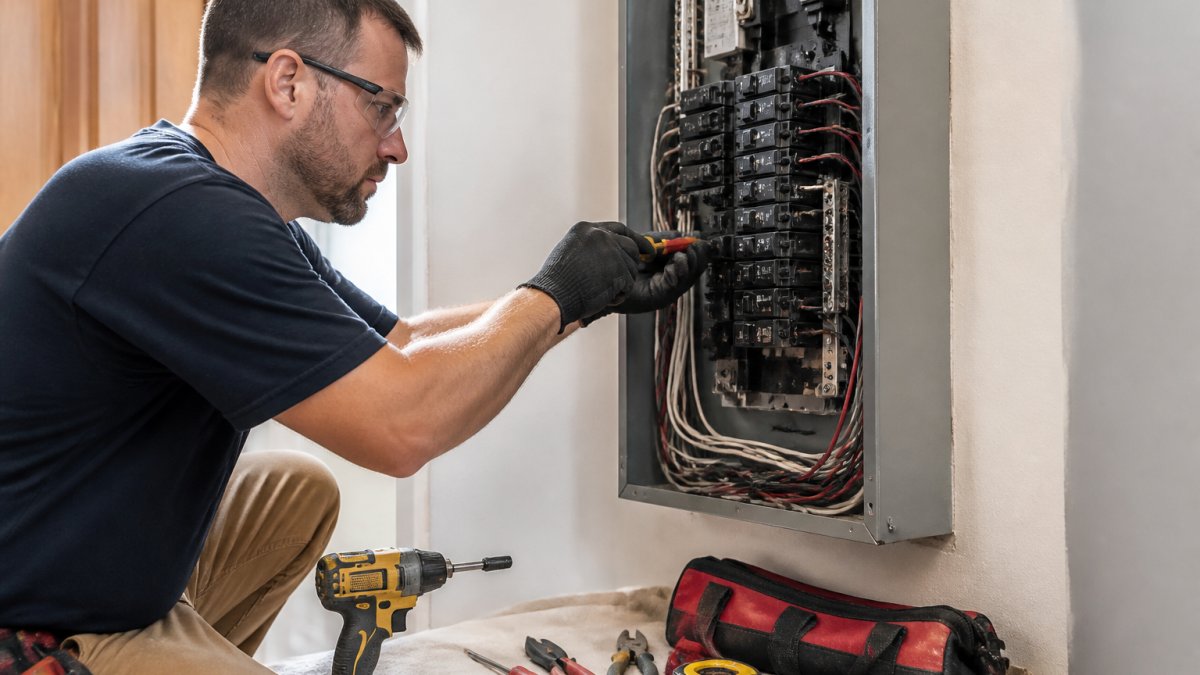
Here’s how a panel upgrade runs, start to finish. Most jobs take one to two days on site, plus permit and inspection time.
Phase 1: Assessment and Load Calculation (Day 1)
We check the service, panel, and wiring, then run the load math. You’ll want to have your appliance list ready, nameplate photos help. We confirm whether you need a panel swap, a service upgrade, or both.
Your role: Gather your list, note any appliances you plan to add in the next few years, and clear access to the panel area.
Phase 2: Permit Application (Days 1-5)
We pull the permit with your municipality. This is required and not optional. Permit fees vary by municipality and are usually based on the job value or a flat fee schedule. The permit application often requires a load calculation and a site plan showing the panel location.
Your role: Nothing, unless the municipality requires a homeowner signature. We handle the paperwork.
Phase 3: Utility Coordination (Days 3-10)
The utility has to disconnect and reconnect power. This is the step that most often stretches the timeline, because utility scheduling queues vary widely. In some service areas, the disconnect and reconnect can be booked within a few days. In others, it can take two weeks or more.
Your role: Be available on the scheduled day. The utility may need access to the meter base.
Phase 4: Panel Removal and New Installation (Day 1 of on-site work)
Power off, old panel out, wiring labeled and set aside. The new panel goes in, grounded and bonded to code. Existing circuits reconnect, and new dedicated circuits get added. This is the bulk of the on-site work, typically one long day for a straightforward swap, longer if the service entrance or meter base also changes.
Your role: Plan for a full day without power. Move perishables, charge devices, and arrange for any medical equipment that needs power.
Phase 5: Inspection (Days 1-5 after installation)
The electrical inspector signs off on the work. Inspection scheduling varies by municipality, some inspect next-day, others take a week. The inspector checks grounding, bonding, breaker sizing, and circuit labeling. If anything fails, we correct it and re-inspect.
Your role: Nothing. We meet the inspector on site.
Phase 6: Power Restoration and Walkthrough (Same day as inspection, usually)
The utility reconnects, and we test every circuit. After we leave, you get a labeled panel and a walkthrough of what changed. If anything trips in the first weeks, call us. Our 48-hour on-site response covers urgent issues.
Never restore power to a panel yourself after a utility disconnect. The utility controls the reconnect for a reason, the service entrance and meter base must be verified before energizing. Wait for the utility’s crew.
The two phases most likely to delay your project are permit approval and utility scheduling, not the installation itself. Ask your electrician for realistic timelines for your municipality and utility before you commit to a start date, and plan for a full day without power during installation.
Frequently Asked Questions
Can I upgrade my electrical panel myself?
An electrical panel upgrade is not a do-it-yourself job. In most of Canada, panel work requires a permit and must be done by a licensed electrician, followed by an inspection. Working inside a live service panel risks serious injury, and an unpermitted upgrade can void insurance coverage and cause problems when you sell your home. A licensed electrician also handles utility coordination for the temporary disconnect and reconnect, which homeowners cannot arrange on their own.
Can you upgrade an electrical panel without rewiring the house?
In many cases, yes. If the existing branch wiring is in good condition and meets current code, an electrician can replace the panel and breakers while leaving the circuits in place. The decision hinges on the condition and type of the wiring, not the panel itself. Older wiring such as aluminum branch circuits or knob-and-tube may need partial or full replacement, and your electrician should assess this before quoting the electrical panel upgrade so there are no surprises mid-project.
How do I know if my panel can handle new appliances?
Ask for an electrical load calculation for home appliances. An electrician adds up the wattage of everything in the home, applies demand factors, and compares the total to your panel’s amperage. A 100-amp service with electric heat, a hot tub, and an EV charger will often be at or over capacity, while a 200-amp service usually leaves room. If the calculation shows the load exceeds roughly 80% of capacity, an upgrade or load management device is worth discussing.
How long does an electrical panel upgrade take?
The on-site work for a straightforward panel replacement typically takes one day, but the full project timeline runs longer. Add time for the permit application, scheduling the utility disconnect and reconnect, and the inspection. In practice, most homeowners should plan for one to three weeks from booking to final inspection, depending on permit office and utility scheduling in their area. Your electrician should give you a written timeline before work begins.
A panel that trips, buzzes, or runs out of slots is a safety issue, not just an inconvenience. Bighorn Electric brings licensed, insured, and bonded electricians to every job, with over a decade of experience across homes, farms, and commercial sites. We handle the load calculation, the permit, the utility coordination, and the inspection, and we quote the job before we start. Book online with Bighorn Electric and get your home’s power ready for the appliances you actually run.


0 Comments