
Table of Contents
- 1. Frequent Circuit Breaker Trips and Blown Fuses
- 2. Flickering or Dimming Lights Across the House
- 3. Burning Smells, Charred Outlets, or Warm Switches
- 4. Buzzing or Sizzling Sounds and Other Signs of Faulty Wiring in a House
- 5. Outdated Wiring Materials: Aluminum Wiring and Knob-and-Tube
- 6. Missing RCD Protection, Two-Prong Outlets, and No Grounding
- 7. What It Costs: The Cost to Rewire a House and How Long It Takes
- 8. Electrical Panel Upgrade vs Rewiring: Which Do You Need?
- Frequently Asked Questions
Last Updated: October 6, 2026
1. Frequent Circuit Breaker Trips and Blown Fuses
If your breaker trips every time the kettle and microwave run together, it is one of the 10 signs your home needs rewiring. A breaker that trips once is normal; one that trips weekly is a warning.
A circuit breaker is a safety switch that cuts power when a circuit pulls more current than its wiring can safely carry. Frequent trips mean the circuit is overloaded, the breaker is worn out, or the wiring can no longer handle the load.
Watch for these patterns:
- The same breaker trips again and again
- Fuses blow within days of replacement
- The panel feels warm near one breaker
- Trips happen when appliances start up
Older homes in the East Kootenays often run modern appliances on circuits sized for a lighter load. Add a heat pump, hot tub, or EV charger, and the math stops working. It is the first sign homeowners notice, and the easiest to dismiss.
Resetting a breaker repeatedly without finding the cause can overheat the wiring behind your walls. That heat degrades insulation and raises fire risk. If a breaker trips more than twice in a month, book an inspection.
2. Flickering or Dimming Lights Across the House
Lights that dim when the fridge kicks on point to a voltage drop, not a bad bulb. Voltage drop is the loss of electrical pressure as current travels through long or undersized wires. The further the power travels, the weaker it gets.
One flickering lamp is usually a loose connection at the fixture. Lights dimming across several rooms is a circuit problem. Lights dimming across the whole house points to the panel or the service entrance.
Here is how to tell them apart:
- One room only: check the fixture and switch
- Several rooms at once: suspect the circuit
- Whole house during appliance start-up: suspect the panel or service
- Constant flicker with no pattern: suspect a loose neutral
A loose neutral is the one to take seriously: it can send uneven voltage through your home and damage electronics. Licensed electricians treat it as urgent.
3. Burning Smells, Charred Outlets, or Warm Switches
A burning smell near an outlet is never normal, and neither is a warm switch plate. Both mean heat is building where it should not.
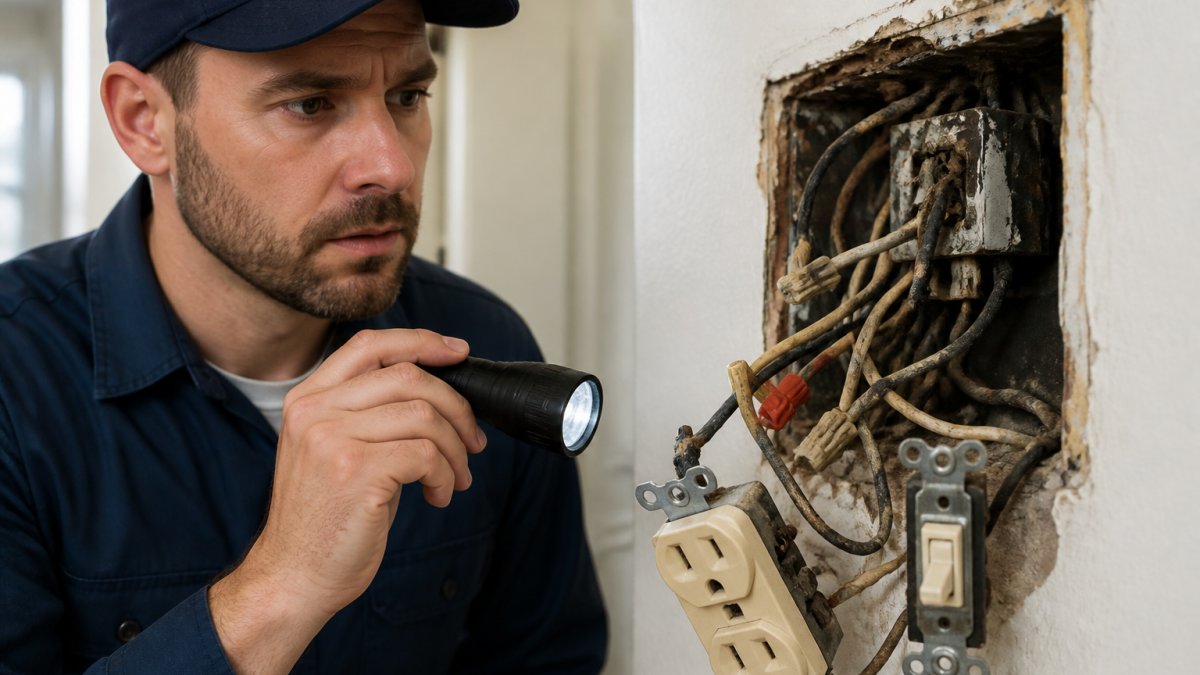
Charred outlets and warm switches are signs of faulty wiring in a house that has already begun to fail. The wire insulation is breaking down, or a connection has worked loose and is arcing behind the wall.
Check these spots:
- Outlets that feel hot or look discolored
- Switch plates that are warm after normal use
- A fishy or plastic smell with no obvious source
- Scorch marks around any power point
Stop using that outlet and call an electrician. According to Electrical Safety Authority guidance on electrical fire risks, overheating connections are a leading cause of residential electrical fires. This is not a wait-and-see problem.
4. Buzzing or Sizzling Sounds and Other Signs of Faulty Wiring in a House
A faint hum from a dimmer switch is common. A buzz, crackle, or sizzle from an outlet or panel is not.
Buzzing or sizzling sounds usually mean electricity is arcing across a loose connection. Arcing creates heat and can ignite nearby material, one of the clearest signs of faulty wiring in a house, and one of the most dangerous.
Listen for:
- A buzz at a specific outlet or switch
- A crackling sound inside the panel
- A sizzle that stops when you unplug a device
- A hum that gets louder under load
If the sound comes from the panel itself, keep your distance and call for help. Do not open the panel cover. A licensed electrician has the tools and training to trace the arc safely.
Before you call, note which breaker controls the noisy outlet and whether the sound changes when you turn appliances on. That detail saves diagnostic time and often shortens the visit.
5. Outdated Wiring Materials: Aluminum Wiring and Knob-and-Tube
Two wiring types show up in older homes and both need attention. Knowing which one you have changes the fix and the cost.
Aluminum wiring was widely installed in branch circuits from roughly the mid-1960s into the late 1970s, when copper prices spiked. The problem is not the metal itself, it is the termination.
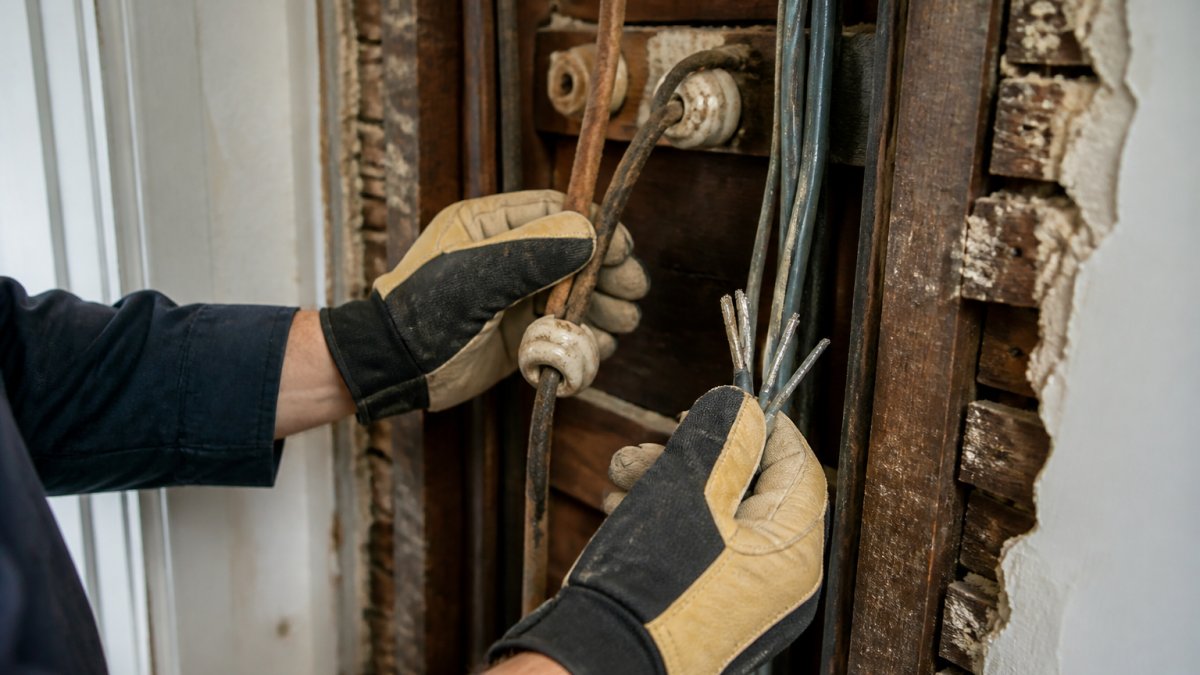
Knob-and-tube wiring predates that, common into the 1940s and still found in some homes into the early 1950s. Conductors run through ceramic knobs and tubes with no ground conductor, and the insulation is often cloth or rubber that has dried out and cracked.
Signs you may have them:
- Cloth-wrapped, fabric-covered, or brittle rubber-insulated wires in the basement or attic
- Ceramic knobs or tubes visible in joists, attic framing, or wall cavities
- Silver-colored conductors at outlets and switches (aluminum) versus copper
- No ground wire at any outlet, or a ground wire added later that does not trace back to the panel
- A fuse box rather than a breaker panel, which often dates the whole system
Neither type is automatically illegal, but both raise real questions at inspection and at the insurance desk. Many insurers want documentation, an inspection report, an upgrade, or both, before writing or renewing coverage on a home with aluminum branch circuits or knob-and-tube. That is a practical reason to act, not just a safety one.
What remediation actually looks like:
- Full replacement is the clean answer: pull the old conductors and run new copper with a proper ground. Highest cost, highest certainty.
- Aluminum-specific remediation exists short of a full rewire, approved connectors and pigtailing methods that address the termination problem at each device. It is recognized, but not a blanket fix, and it does not address undersized circuits or a lack of grounding.
- Knob-and-tube generally has no partial fix worth relying on. Once insulation is brittle and the circuit has been modified, replacement of the affected circuits is the realistic path.
Do not assume a home is safe because the wiring “looks old but works.” Aluminum and knob-and-tube fail at connections and hidden splices, not at the switch you can see. An inspection that opens a representative sample of outlets, switches, and the panel is the only way to know what you actually have.
6. Missing RCD Protection, Two-Prong Outlets, and No Grounding
Two-prong outlets have no ground path, so a fault has nowhere safe to go and the shock risk lands on you.
Grounding gives electricity a safe route back to the panel if something goes wrong. Without it, a metal appliance casing can become live. An RCD, or residual current device, is a safety switch that cuts power within milliseconds when it senses a leak to ground. In Canada, ground fault circuit interrupter protection is required in wet areas like bathrooms, kitchens, and outdoors.
Check for these gaps:
- Two-prong outlets in bedrooms and living areas
- No RCD or GFCI protection in bathrooms or near sinks
- Outdoor outlets without a weatherproof cover
- A fuse box with no modern safety switches
If your home still runs on a fuse box, this is the moment to talk about an upgrade. It is cheaper to fix a known gap than to repair fire damage.
7. What It Costs: The Cost to Rewire a House and How Long It Takes
The cost to rewire a house depends on size, age, wiring type, and wall access. There is no single number, and any electrician who quotes one over the phone is guessing.
What drives the cost:
- Square footage and number of circuits
- Whether walls are open (renovation) or closed (finished)
- Aluminum or knob-and-tube removal
- Panel upgrade needed or not
- Fixtures, outlets, and switches being replaced
- Whether the home is occupied during the work
| Factor | Lower Cost | Higher Cost |
|---|---|---|
| Home size | Small, single level | Large, multi-level |
| Wall access | Open during renovation | Finished, closed walls |
| Wiring type | Copper, modern | Aluminum or knob-and-tube |
| Panel | Already upgraded | Needs replacement |
| Scope | Partial rewire | Full rewire |
| Occupancy | Vacant | Occupied, staged around daily life |
The same variables answer how long does it take to rewire a house. A small home with open walls moves fast; a large finished home with old wiring takes far longer because the work happens behind drywall, and each circuit must be traced, isolated, and restored.
The insurance angle most articles skip. Outdated wiring does not just affect fire risk, it affects your coverage.
The resale angle. A documented rewire or panel upgrade is a selling point, not just a sunk cost. Buyers and their inspectors flag old wiring, and a home that has already been brought up to modern standards removes a negotiation chip from the table.
Can you rewire in stages? Often, yes, and for many homeowners that is the only realistic path.
For a firm number, book a site assessment. We quote from what we see, not from a phone estimate.
Ask for a written scope that separates the panel, the high-risk circuits, and the remaining circuits. That breakdown is what lets you decide between a full rewire now and a phased plan, and it is what your insurer and your future buyer will want to see.
8. Electrical Panel Upgrade vs Rewiring: Which Do You Need?
The choice between an electrical panel upgrade vs rewiring comes down to where the problem lives. If the wiring is sound but the panel is old or too small, you need a panel upgrade. If the wires themselves are failing, you need a rewire.
An electrical panel upgrade replaces the main breaker box to add capacity and modern safety devices. A rewire replaces the wiring throughout the home. They solve different problems, and sometimes you need both.
Use this to decide:
- Breakers trip from overload, wiring looks fine: panel upgrade
- Wiring is aluminum, knob-and-tube, or damaged: rewire
- Adding a heat pump, hot tub, or EV charger: often both
- Fuse box with no RCD protection: panel upgrade first
A phased approach works well for many homeowners: start with the panel and highest-risk circuits, then plan the rest around your renovation schedule and budget. That spreads the cost and keeps the power on.
You do not always need a full rewire. A licensed electrician can test your circuits and tell you which parts are safe and which need replacing. Get that answer before you commit to a large project.
The 10 signs your home needs rewiring do not announce themselves until something fails, and by then the damage is done. At Bighorn Electric, our licensed, insured, and bonded electricians inspect, repair, and upgrade home electrical systems across the East Kootenays, backed by a 48-hour on-site response for urgent issues and clear communication on every ETA.
Frequently Asked Questions
How much should a full house rewire cost?
The cost to rewire a house depends on size, age, accessibility, and whether the electrical panel also needs replacing. Older homes with knob-and-tube or aluminum wiring typically cost more because removal is labor-intensive. A licensed electrician should assess your home and provide a written quote that separates wiring, panel work, and any drywall repair. Bighorn Electric can give you a clear, itemized estimate before any work begins.
Can I upgrade my electrical panel without rewiring my house?
Yes, in many cases. If your wiring insulation is intact and grounding is adequate, a panel upgrade alone can add capacity and modern RCD protection without touching the branch circuits. However, if an electrician finds degraded insulation, aluminum wiring, or no grounding, a panel swap may not be enough to meet current electrical safety requirements. An inspection will confirm which path makes sense for your home.
What age should a house be rewired?
There is no fixed age, but homes built before the 1950s often have knob-and-tube wiring, and homes from the 1960s and 1970s may have aluminum branch circuits. Both materials degrade and may not handle modern electrical loads. If your home is 40 or more years old and has never had an electrical safety inspection, book one to check insulation, grounding, and panel capacity before adding new appliances or renovations.
Can you live in a house while it is being rewired?
In most cases, yes. Electricians usually work room by room and restore power at the end of each day. Expect some noise, brief outages, and small wall openings for new cable runs. If the panel must be replaced, you will lose power for several hours. Planning the work in phases lets you stay in the home and spread the cost, which is one reason phased rewiring strategies are common for older properties.


0 Comments