
Last Updated: November 1, 2026
Quick Summary
The most important electrical safety upgrades for older homes start with the electrical panel, because it controls every circuit in the house. Next come replacing damaged or outdated wiring, adding GFCI protection in wet locations, inspecting aluminum wiring, improving grounding and bonding, and installing AFCI protection with working smoke alarms. A licensed electrician can set the order based on your home’s load and condition.
- Start with the electrical panel, since it controls everything else in the home.
- Treat a panel with fuses, double-tapped breakers or corrosion as a sign to plan an upgrade.
- Test GFCI outlets monthly by pressing the test button.
- Verify grounding and bonding before or during the panel upgrade, not after.
- Get a written quote that separates the panel, service entrance, grounding and permit fees.
Table of Contents
- Why Older Homes Need a Different Safety Check
- 1. Upgrading the Electrical Panel
- 2. Replacing Outdated or Damaged Wiring
- 3. Rewiring an Old House: When Partial Work Is Not Enough
- 4. Adding GFCI Protection in Wet Locations
- 5. Inspecting and Repairing Aluminum Wiring
- 6. Improving Grounding and Bonding
- 7. Installing AFCI Protection and Smoke Alarms
- Frequently Asked Questions
Why Older Homes Need a Different Safety Check
Older Canadian homes were wired for a very different load than today’s kitchens, home offices and electric vehicle chargers.
Homeowners in the East Kootenays often see the same warning signs again and again. The good news is that most risks can be found and fixed in a logical order.
Here is how we would approach the job:
- Start with the panel, because it controls everything else
- Replace wiring that is damaged, brittle or unsafe
- Add protective devices like GFCI and AFCI breakers
- Check grounding and bonding throughout the house
- Confirm smoke alarms are working and in the right places
Keep in mind that many older homes need a mix of these fixes, not just one. A licensed electrician can tell you which ones matter most for your house.
1. Upgrading the Electrical Panel
Your electrical panel is the heart of your home’s power system. In many older homes, the panel is too small for today’s loads, or it uses outdated breakers that may not trip reliably. Older homes often have panels with fuses, double-tapped breakers or corrosion around the bus bars.
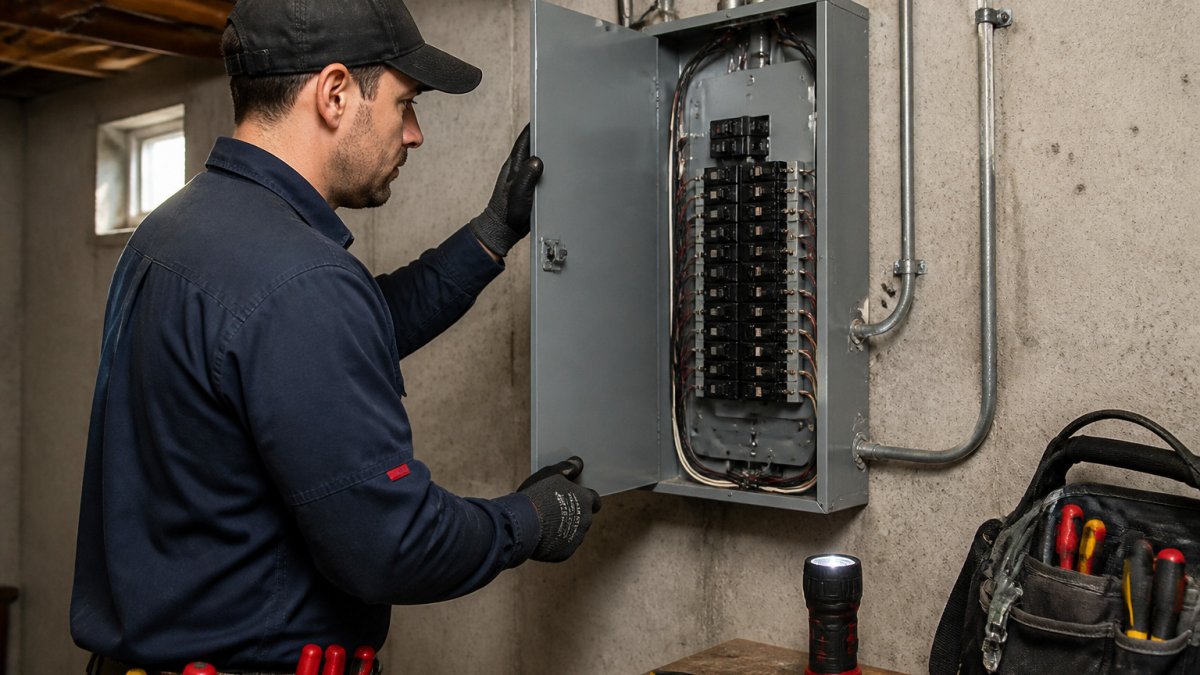
A panel upgrade usually means moving to a larger service, often 100 amps up to 200 amps, depending on your home’s needs. Read our step-by-step guide to how a panel upgrade is done. The exact scope depends on your load, the panel brand and local inspection rules.
How to tell whether you need a panel upgrade
A licensed electrician will run a load calculation, but a few homeowner-visible symptoms point toward a service upgrade:
- The panel has fuses rather than circuit breakers, or it is a known problem brand that insurers flag
- Breakers trip when the oven, dryer and a space heater run together
- There is no room for new circuits for a heat pump, EV charger or finished basement
- The service mast, meter base or panel shows rust, scorch marks or double-tapped breakers
- You are planning a major renovation or adding a secondary suite
If two or more of these apply, budget for a service upgrade rather than another round of patch repairs.
What a panel upgrade typically involves
A full service upgrade is more than swapping the box. It usually includes a new panel and main breaker, a new meter base and service mast where required, upgraded grounding and bonding at the service entrance, and new circuit breakers. The utility may need to disconnect and reconnect power, which affects scheduling.
Never open a panel to inspect it yourself. Even with the main breaker off, the service conductors and parts of the panel can stay energized. Panel work is a job for a licensed electrician.
Permits, inspection and sequencing
In most jurisdictions, a service upgrade requires an electrical permit and an inspection before the utility reconnects power. Requirements vary by province and municipality, so confirm the process with your local authority before work starts. Skipping the permit can complicate insurance and resale.
Sequence the panel upgrade before other work where possible. Adding GFCI or AFCI breakers, a surge protective device or circuits for a new heat pump all depend on having panel space and capacity. Doing the panel first avoids paying twice for breakers and labour.
Budgeting factors
Costs vary widely with service size, distance from the utility connection, whether the meter base and mast must be replaced, and whether walls need opening. Ask for a written quote that separates the panel, the service entrance, grounding and permit fees, and ask whether utility charges are included.
Treat the panel as the foundation upgrade. Confirm capacity, permit requirements and utility coordination first, then let the remaining six upgrades follow in risk order.
2. Replacing Outdated or Damaged Wiring
Older wiring is one of the biggest safety concerns in an older house. Knob-and-tube wiring, cloth-insulated cables and wiring with brittle or cracked insulation can overheat or create shock hazards over time.
Replacing wiring means running new cable through walls and ceilings, which is labour-intensive. Plan for patching drywall and painting afterward. In some cases, a targeted replacement of only the worst circuits makes more sense than a full rewire.
Call an electrician right away if you notice any of these: Check the full list of warning signs that point to a rewire
- Scorch marks around outlets or switches
- Outlets that feel hot to the touch
- Breakers that trip often
- Insulation that crumbles when touched
3. Rewiring an Old House: When Partial Work Is Not Enough
Sometimes a few repairs will not solve the problem. See which electrical services we offer for rewiring work.
A full rewire is a major project. It can take days or weeks, and it often happens while the home is partly or fully empty.
Partial work can still make sense in some cases. A common approach is to rewire the kitchen, bathrooms and main living areas first, then tackle the rest as your budget allows.
If you want help deciding, our Canadian Electrical Code overview is a good place to start learning about the rules that apply to wiring work.
4. Adding GFCI Protection in Wet Locations
Ground-fault circuit interrupters, or GFCIs, shut off power very quickly when they sense current leaking to ground.
Many older homes have none of these. Adding GFCI protection can be done by replacing a standard outlet with a GFCI outlet, or by installing a GFCI breaker at the panel. Plan the electrical layout for a basement finish before you start.
Here is a quick checklist for wet locations:
- Kitchen counter outlets
- Bathroom outlets
- Garage and basement outlets
- Outdoor outlets and exterior receptacles
- Laundry room outlets
Test your GFCI outlets monthly by pressing the test button. If the outlet does not trip or reset, have it replaced.
5. Inspecting and Repairing Aluminum Wiring
Some homes built in the 1960s and 1970s used aluminum wiring for branch circuits. Aluminum expands and contracts more than copper, and that movement can loosen connections over time. Loose connections create heat, which is a fire risk.
If your home has aluminum wiring, an electrician can inspect the connections at outlets, switches and the panel. Repairs may include installing special connectors, replacing devices with ones rated for aluminum or rewiring the affected circuits with copper.
Having aluminum wiring inspected before buying an older home is a sound step. Do not ignore it, even if the system seems to work fine.
6. Improving Grounding and Bonding
Grounding and bonding give electrical current a safe path to earth if something goes wrong. Many older homes have two-prong outlets with no ground at all, or grounding that is incomplete. Without proper grounding, appliances and surge protectors may not work as designed, and fault current may travel through plumbing or people instead of the intended path.
Grounding versus bonding
Grounding connects the electrical system to earth through the grounding electrode system at the service entrance. Bonding connects metal parts that should stay at the same voltage, such as metal water pipes, gas piping and the panel enclosure, so they cannot develop a dangerous difference in potential. Both matter, and both are checked at the service and throughout the house.
How to spot grounding problems
- Two-prong outlets with no ground path
- Three-prong outlets installed on old two-wire circuits without a proper ground
- A ground rod that is loose, corroded or missing
- Metal water piping that is not bonded across the water meter or at the entry point
- A panel with no visible grounding electrode conductor
A common mistake is assuming an outlet is grounded because it has three holes. Test it with a receptacle tester or have an electrician verify the connection. A tester can show an open ground, a reversed polarity or a bootleg ground, where the neutral is improperly tied to the ground terminal.
What improvements look like
Improvements can include running a ground conductor to outlets on general-purpose circuits, bonding metal water and gas piping, confirming the grounding electrode system at the service entrance, and upgrading the connection between the panel and the ground rod. Where running a ground wire is impractical, a GFCI outlet can provide shock protection on an ungrounded circuit, but it does not create a ground path and should be labeled as ungrounded.
Sequencing with the panel and protective devices
Grounding work is best planned alongside the panel upgrade, because the service entrance is the natural point to verify the electrode system and bonding. If AFCI or GFCI breakers are being added, confirm grounding and bonding first so the protective devices operate as intended. Surge protective devices also depend on a low-impedance ground path to divert surges effectively.
Ask your electrician to document the grounding and bonding check in writing, including the condition of the ground rod, the water bond and any ungrounded circuits. That record is useful for insurance and resale.
Grounding and bonding are not glamorous, but they underpin every other safety device in the house. Verify them before or during the panel upgrade, not after.
7. Installing AFCI Protection and Smoke Alarms
Arc-fault circuit interrupters, or AFCIs, detect dangerous electrical arcing, the kind that can start fires inside walls. AFCI protection is now common in new construction, and adding it to an older home can reduce fire risk in bedrooms, living areas and other rooms.
Smoke alarms are the other half of this upgrade. Working smoke alarms give you early warning, and many older homes have alarms that are expired, missing or wired incorrectly.
Protective devices are a good place to start, but they work best together with a solid electrical system. Learn how to find reliable electricians for this kind of work.
Frequently Asked Questions
What are the 7 electrical tests?
An electrical inspection of an older home typically checks the panel and main service, grounding and bonding, the condition of the wiring, outlet polarity and grounding, GFCI and AFCI function, switch and fixture condition, and insulation resistance on circuits where wiring condition is in doubt. Tests are performed with calibrated meters by a licensed electrician. Results identify which upgrades from this list are urgent and which can be scheduled. Ask for a written report that lists each finding and its recommended fix, so you can compare quotes and plan the work in stages.
Can I upgrade my electrical panel without rewiring my house?
Yes. A panel upgrade replaces the service equipment and breakers without touching most of the branch wiring, so it is often done on its own. It makes sense when the panel is an old fuse box, a brand known for breaker failures, or too small for modern loads such as an electric heat pump, EV charger or hot tub. Whether the existing wiring can stay depends on its type and condition, which an electrician should confirm before the work starts.
Is 100-year-old wiring safe?
Wiring that is around 100 years old, such as knob-and-tube or cloth-insulated wire, should be treated as a hazard. Insulation becomes brittle and cracked, splices are often exposed, and the system was never designed for today’s loads. Knob-and-tube is also frequently covered by insulation, which causes overheating. Insurers may decline coverage or require replacement. A licensed electrician can assess the condition and recommend which circuits to replace first.
Should an electrician inspect the wiring before I renovate an older home?
Yes. Inspecting before renovation lets you find wiring types, undersized circuits and hidden damage while walls are still closed, when repairs are cheaper and simpler. Walls, ceilings and floors are much easier to open before new finishes go in. The inspection also helps you plan new outlets, lighting and appliances so they fit the existing capacity. Ask the electrician to note any permit requirements for the planned work.
If your older home needs any of these upgrades, Bighorn Electric can help. Our licensed, insured and bonded electricians offer a 48-hour on-site response for urgent electrical issues, and we will explain the options clearly before any work begins. Book online for a home electrical assessment and get a plan you can trust.


0 Comments