
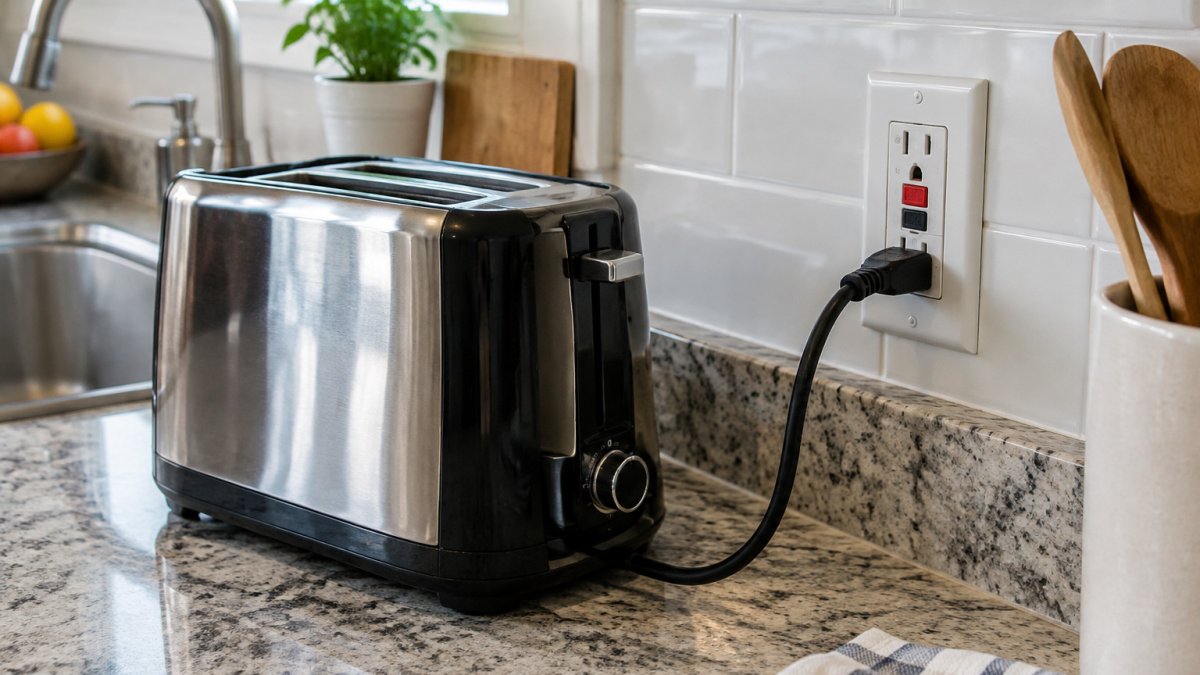
Last Updated: November 4, 2026
Quick Summary
Kitchen outlets need GFCI protection because water, steam, and damp hands near sinks turn ordinary receptacles into shock hazards, and this is why do kitchen outlets need gfci protection under the Canadian Electrical Code, which treats kitchens as wet locations. A GFCI cuts power within milliseconds when current leaks toward ground, preventing serious injury.
- A GFCI compares outgoing hot-wire current with returning neutral current and trips when they differ.
- Kitchen receptacles near sinks must have GFCI protection under the Canadian Electrical Code.
- One GFCI wired on the load side can protect several downstream outlets along the counter.
- Test GFCI outlets monthly by pressing test, confirming power cuts off, then pressing reset.
- A GFCI that keeps tripping usually signals moisture, a failing appliance, or a wiring fault.
Table of Contents
- Why Do Kitchen Outlets Need GFCI Protection?
- Water and Electricity: The Risk on Every Countertop
- How GFCI Outlets Work to Prevent Shock
- Kitchen GFCI Outlet Requirements Under Canadian Electrical Code
- GFCI vs. AFCI: What’s the Difference?
- GFCI Outlet Test and Reset: A Monthly Routine
- When Your GFCI Outlet Keeps Tripping
- Retrofitting GFCI Protection in Older Kitchens
- Book a Licensed Electrician to Check Your Kitchen GFCI Protection
- Frequently Asked Questions
Why Do Kitchen Outlets Need GFCI Protection?
This guide explains why do kitchen outlets need gfci protection: water, steam, and damp hands turn ordinary countertop receptacles into shock hazards. A ground-fault circuit interrupter cuts power in a fraction of a second when current leaks toward ground.
The kitchen is the busiest electrical room in most homes. Kettles, mixers, coffee makers, and dishwashers all sit within arm’s reach of a sink. That combination is exactly why the Canadian Electrical Code treats kitchens as wet locations.
Here is what most guides get wrong: they list the rules but skip the reason. The reason is simple. Water conducts electricity, and a person touching both a faulty appliance and a grounded surface becomes the path of least resistance.
Below, we break down how GFCI outlets work, what the code requires, and how to fix one that keeps tripping.
Water and Electricity: The Risk on Every Countertop
A ground fault is electricity escaping a circuit and traveling where it should not, often through water or a person. A GFCI watches for that leak and shuts the circuit off before it can hurt anyone.
The hazard is easy to picture. Your hands are wet from rinsing vegetables. You reach for a blender with a frayed cord. The current leaks through the metal housing, into your arm, and down to the grounded sink.
- Spilled water on a countertop
- Steam condensing on outlets near the stove
- Damp hands reaching for a plug
- Appliances with worn or cracked cords
Electrical shock can cause burns, muscle spasms, and in serious cases electrocution. A standard outlet offers no detection. It keeps supplying power until something breaks the circuit, and that something could be you.
How GFCI Outlets Work to Prevent Shock
A GFCI outlet is a receptacle that compares the current flowing out on the hot wire with the current returning on the neutral wire. When the two differ by a tiny amount, the device assumes current is leaking and trips within milliseconds.
That speed is the whole point. A fraction of a second is enough to prevent serious injury. The device responds to current leakage, not to a full short circuit, so it catches problems a standard breaker never sees.
Here is how the parts work together:
- Line side: the incoming power from your electrical panel
- Load side: the wiring that feeds downstream outlets
- Fault detection: the internal sensor that spots the imbalance
- Test and reset buttons: the manual controls for checking the device
One GFCI can protect several outlets when wired on the load side. That is why a single device near the sink often guards every receptacle along the counter.
Kitchen GFCI Outlet Requirements Under Canadian Electrical Code
Kitchen receptacles near sinks must have GFCI protection under the Canadian Electrical Code. The code treats these as wet locations because of the water and damp conditions. Rules vary by province, so confirm local requirements with your authority having jurisdiction.
The Canadian Electrical Code, published by CSA Group sets the baseline that provinces adopt and amend. Electrical inspectors enforce the version in force where you live. For a remodel, check the Electrical Safety Authority guidance on GFCI protection before work begins.
Which Kitchen Receptacles Must Be Protected
Protection generally applies to countertop outlets near sinks, dishwashers, and any receptacle serving wet areas. Protection generally applies to countertop receptacles within reach of a sink. In practice, inspectors interpret “within reach” as any outlet that could be used by someone standing at the sink with wet hands. Here is a practical checklist to consider:
- Countertop receptacles within reach of a sink
- Outlets serving the dishwasher
- Receptacles near the fridge water line
- Any outlet in a damp or wet location
- Outlets within the splash zone of the range
A common mistake is assuming every kitchen outlet needs its own GFCI device. It does not. One device on the line side can protect the rest on the load side, which saves money and keeps the wall clean. A GFCI device should be readily accessible so it can be tested and reset. Confirm the current requirements with your local authority having jurisdiction.
A licensed electrician can tell you which GFCI option applies to your layout.
If you are planning a full remodel, our guide to 5 essential electrical requirements for kitchen remodeling covers the wider set of code items beyond GFCI.
GFCI vs. AFCI: What’s the Difference?
GFCI and AFCI devices protect against different hazards. A GFCI guards people against shock from current leakage. An AFCI guards the wiring against fires caused by arcing. Most kitchen guides stop there, but the distinction matters more in a kitchen than almost any other room because both hazards are present.
Think of it this way. GFCI is about you. AFCI is about the house. Some kitchen circuits benefit from both devices working side by side.
- GFCI: detects ground faults and current leakage
- AFCI: detects dangerous electrical arcs
- Both: trip fast to cut power and prevent harm
- Together: cover shock risk and fire risk
Why the Confusion Happens in Kitchens
A kitchen is unusual because it combines water (the GFCI hazard) with high-current appliances and older wiring (the AFCI hazard). A microwave with a failing internal component can arc without tripping a GFCI, because the current is not leaking to ground. Conversely, a kettle with a cracked heating element can leak current to the metal housing and trip a GFCI without ever producing an arc.
What most reviews miss is that a tripping AFCI is not the same problem as a tripping GFCI. They signal different faults. Knowing which device tripped saves a lot of guesswork. If the device has a “TEST” button and a “RESET” button but no “AFCI” label, it is a GFCI. If it has a label that says “AFCI” or “Combination AFCI,” it is an AFCI.
A Kitchen-Specific Example
Suppose your countertop outlet keeps tripping. You unplug the toaster and the trips stop. That points to a ground fault inside the toaster, and a GFCI did its job. Now suppose the same outlet trips only when the refrigerator compressor kicks on.
Watch out: replacing an AFCI with a standard breaker to stop nuisance trips removes fire protection from the circuit. Removing AFCI protection is not a fix for nuisance trips.
If you are unsure which device you have or which one is tripping, a licensed electrician can identify it and trace the fault. Our article on 7 electrical safety upgrades for older homes covers how AFCI and GFCI protection fit into a broader safety plan.
GFCI Outlet Test and Reset: A Monthly Routine
Test GFCI outlets regularly. Press the test button, confirm the power cuts off, then press reset to restore it.
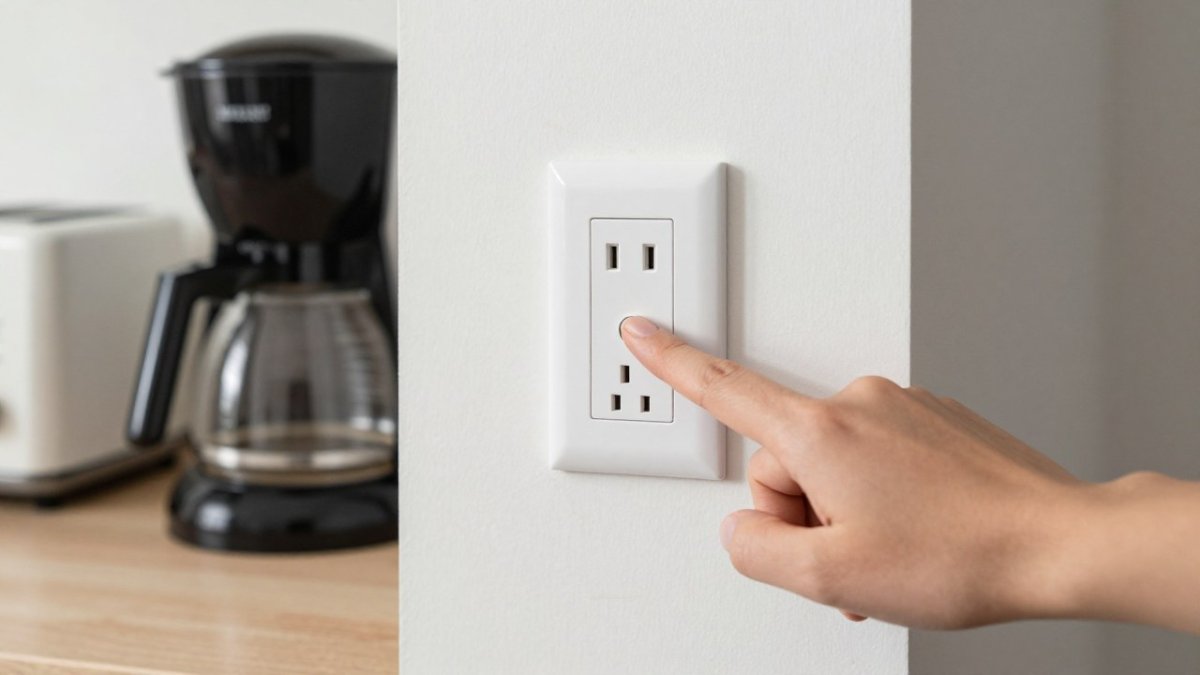
Here is a simple routine to follow:
- Plug a small lamp into the outlet.
- Press the test button. The lamp should go dark.
- Press reset. The lamp should come back on.
- If the lamp stays off, the device or wiring needs attention.
A GFCI that will not reset is a warning sign. It may have failed internally or detected a real fault. Do not tape over the buttons or ignore it.
When Your GFCI Outlet Keeps Tripping
A GFCI that keeps tripping is usually sensing a real problem, not being overly sensitive. Find the cause before you swap the device. Repeated nuisance trips often point to moisture, a failing appliance, or a wiring fault.
Troubleshooting Nuisance Trips
Work through these steps in order. Most nuisance trips trace back to one of them.
- Unplug appliances one at a time. A faulty kettle or mixer is a common culprit.
- Check for moisture. Damp outlets near the sink trip more often.
- Inspect the load-side wiring. Loose connections cause false trips.
- Look for a shared neutral. A miswired circuit confuses the sensor.
- Test a replacement device. If trips continue, the wiring is the issue.
Watch out: replacing a tripping GFCI with a standard outlet removes your shock protection. That is the exact mistake the code exists to prevent.
For quick answers to common electrical questions before you call a pro, browse our full resource library.
Retrofitting GFCI Protection in Older Kitchens
Older kitchens often have ungrounded two-prong outlets with no GFCI protection. Retrofitting is possible without rewiring the whole house. A GFCI can protect an ungrounded circuit and guard against shock.
The options depend on your wiring:
| Situation | Best Fix | Notes |
|---|---|---|
| Ungrounded outlets | GFCI receptacle at first outlet | Protects downstream outlets |
| No ground wire at panel | GFCI breaker | Protects the whole circuit |
| Old fabric wiring | Full inspection first | May need partial rewiring |
| Remodel in progress | GFCI plus AFCI | Meets modern code |
A common mistake is installing a GFCI at the end of a daisy-chained run. Put it at the first outlet so every downstream receptacle gets protection. Owners of older homes can find broader guidance in our article on 7 electrical safety upgrades for older homes.
Book a Licensed Electrician to Check Your Kitchen GFCI Protection
Testing a GFCI is a job you can do yourself. Diagnosing a tripping device, retrofitting an old circuit, or confirming code compliance is a job for a licensed electrician. That is where a licensed electrician comes in.
Our licensed, insured, and bonded electricians handle electrical repairs and installations for residential and commercial clients. Urgent electrical needs are covered by a 48-hour on-site response guarantee.
- Licensed, insured, and bonded electricians
- Over 14 years of experience
- 48-hour on-site response for urgent issues
- Tailored solutions for homes and businesses
See what our residential services cover, or contact us to book a visit.
Frequently Asked Questions
Do all kitchen outlets need GFCI protection?
Not every receptacle in the room needs it, but receptacles that serve countertops near sinks generally do. Confirm the current requirements with your local authority having jurisdiction. If you are unsure which of your kitchen receptacles are covered, a licensed electrician can map the circuit and confirm.
Can one GFCI outlet protect other kitchen outlets on the same circuit?
Yes. A single GFCI receptacle can protect downstream outlets wired to its load side, a practice called daisy-chaining. Everything connected after the GFCI device gets the same protection. The catch is that a fault anywhere on that chain trips the one device and cuts power to every outlet after it. Labeling which outlets share protection saves time when you are resetting a tripped GFCI.
How do you test a kitchen GFCI outlet?
Press the TEST button on the receptacle. You should hear a click and the RESET button should pop out, cutting power to the outlet. Plug in a small lamp or use a tester to confirm the power is off, then press RESET firmly until it clicks back in. Do this once a month, and replace the device if it fails to trip or will not reset. A GFCI that will not trip is no longer protecting you.
What should you do if a kitchen GFCI outlet keeps tripping?
Unplug everything on that circuit and reset the GFCI. If it holds, plug appliances back in one at a time to find the culprit, paying attention to anything with a heating element or motor. If it trips with nothing plugged in, the fault is in the wiring or the device itself, and moisture in an outdoor or damp location is a common cause. Persistent tripping needs a licensed electrician, not a bigger breaker.
Kitchen outlets sit next to water every day, and that is why GFCI protection matters. If your outlets are untested, old, or tripping, do not wait for a shock to force the issue. Get started with Bighorn Electric and give your kitchen the protection it needs.



0 Comments